
Summary
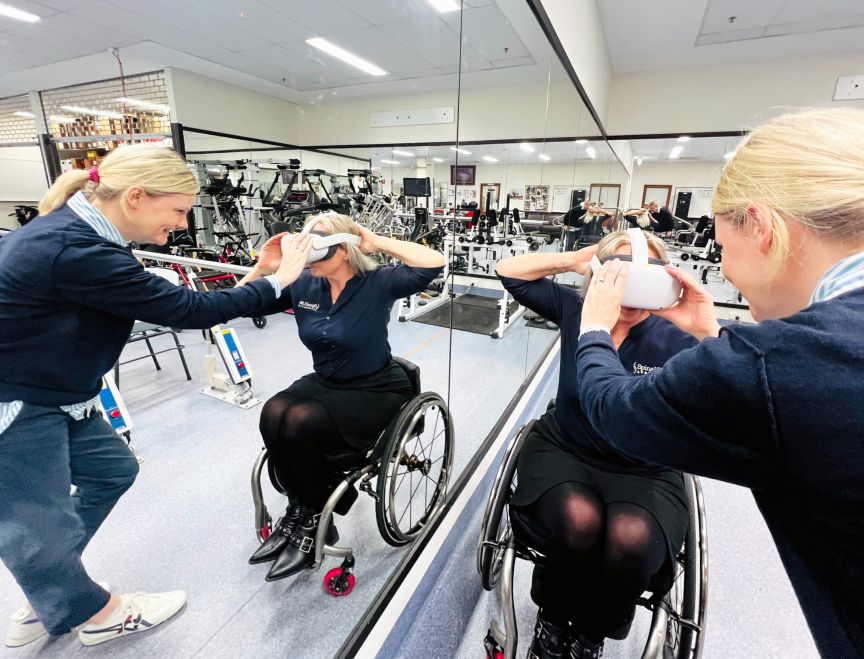
- Virtual Reality research is helping patients with a spinal cord injury learn about falls management in the community.
- In the hospital setting, patients practise falls prevention when interacting with equipment and during wheelchair skills training.
- But research shows many find this irrelevant at the time while they are focussed on regaining their independence.
- Using VR, patients can safely receive education about fall risks and what to do after a fall.
- This practical training in the statewide Spinal Injuries Unit enhanced by VR provides real context for lifelong management and safety.
Falls prevention for patients who use wheelchairs is levelling-up thanks to the introduction of new research using Virtual Reality (VR) training.
The VR tool will help people practise how to manage falls and navigate everyday environments safely, without risk of real-world injury.
Princess Alexandra Hospital occupational therapist, Kathryn Marshall who is leading the research through The University of Queensland said training with VR will directly affect people who use a wheelchair for mobility – particularly those with a spinal cord injury.
“Inpatient rehabilitation within the Spinal Injuries Unit already includes education to prevent falls during wheelchair skills training, activity of daily living practice, use of equipment and home modifications,” Kathryn said.
“Our research, however, shows that people with spinal cord injury find falls education irrelevant or not established as a priority until they have experienced a fall themselves.”
She said this creates a challenge to provide education as the first fall may occur sometime after discharge from health services.
“It is vital that people have the skills needed to manage these falls lifelong. Education that is engaging is needed to bring awareness of risk without introducing harm,” Kathryn said.
The University of Queensland and the National Injury Insurance Scheme, Queensland (NIISQ) are co-designing the VR program with people who use wheelchairs and frontline clinicians.
Kathryn said the research plan is to pilot the program in the inpatient spinal rehabilitation service at PA Hospital with an initial group of 20 participants.
“Individuals who use the program could expect an increase in confidence and increased knowledge which could have a flow effect of increased engagement in society and participation in life.”
The Queensland Government-funded project is currently in development before clinical trials are conducted in mid-2027 after ethics approval.
NIISQ is funding the project to support research which aims to improve recovery, independence and long-term outcomes for people seriously injured in catastrophic incidents like motor vehicle accidents.