
Summary
A national clinical trial for patients with advanced prostate cancer is now underway at PA Hospital with positive results in phase one for stopping tumour growth.
Alongside several sites in the US administering this new drug, Australia has tested the medicine on six prostate cancer patients with similar results.
A national clinical trial for patients with advanced prostate cancer is now underway at Princess Alexandra Hospital (PAH) with positive results for stopping tumour growth.
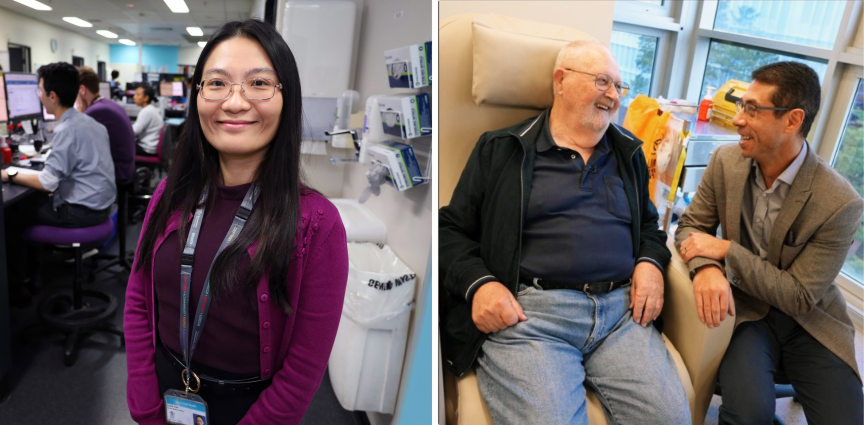
The SNV1521 trial led by PAH medical oncologist, Dr Laura Tam is being conducted by the Translational Trial team at the Translational Research Institute (TRI).
PAH Medical Oncologist and Director of Clinical Trials at TRI, Professor Aaron Hansen said there have been encouraging results from this phase one trial, both here in Australia and internationally.
“Several sites in the US have been administering this new drug to cancer patients since 2024 and the results have so far been very positive in stopping tumour growth, and slowing down the progression of the disease,” Professor Hanson said.
“We have also tested the new medicine on six prostate cancer patients in Australia who have run out of treatment options, and we’ve had similar results in stopping the progression of tumour growth.
“We also found there were less side-effects and adverse reactions compared with many traditional cancer treatments.”
PA Hospital patient David Pilkington has had prostate cancer for the past nine years and had exhausted all treatment options before he became the fifth patient in Australia to trial the new medicine in November 2025.
Diagnosed in 2017 with an aggressive prostate tumour and cancer that had spread into his pelvis, Mr Pilkington had his prostate removed, six rounds of chemotherapy, radiation treatment, hormonal therapy and immunotherapy.
He also went on several cancer drugs that helped slow the progression until they stopped working completely in 2024.
“Chemotherapy made me extremely sick, it was the worst treatment of all of them, and I’ve tried basically everything available,” Mr Pilkington said.
“Then last year Prof Hansen told me about an Australian first trial he was involved in for a new cancer therapy, and I’ve been taking the medication since November, and it has so far stopped the progression of the cancer.
“I feel fantastic and thankfully I have no side-effects; I know I wouldn’t be here if we didn’t have this kind of research, so I’m grateful to be on this trial.”
Twenty new participants* will be needed for the expanded trial across four cities.
September is Prostate Cancer Awareness month, and Australian men are being urged to get their prostates checked with regular PSA screening for all men over 50, and for those with a family history from 40 to 45.
Prostate cancer rates have doubled in men under 50 and continue to rise across all age groups, with around one in five men likely to be impacted in their lifetime.
Associate Professor Jason Lee is a leading cancer researcher from The University of Queensland’s Frazer Institute based at TRI, and he’s just received a $400,000 grant from the TRI Foundation.
This large donation was a generous bequest from a Queensland family and will be used to further A/Prof Lee’s research which aims to find ways to improve immunotherapy treatment in patients that are resistant to it, and to lessen the side-effects.
“Immunotherapy helps the body’s immune system recognise and attack cancer cells but it’s effectiveness depends on the type of tumour someone has, and often it has limited benefit for prostate cancer patients,” A/Prof Lee said.
“What we are trying to do is to enable immunotherapy to work better by allowing the cancer cells to be more easily recognised by the body’s own T-cells which naturally fight cancer.
“What generally kills prostate cancer patients is when the cancer metastasises and spreads throughout the body, but if we can make immunotherapy work better, we can improve the outcomes for patients.”
*Patients interested in the trial need to be referred to the PAH Oncology team as usual through their GP or specialist.
Media produced in partnership with Translational Research Institute.