
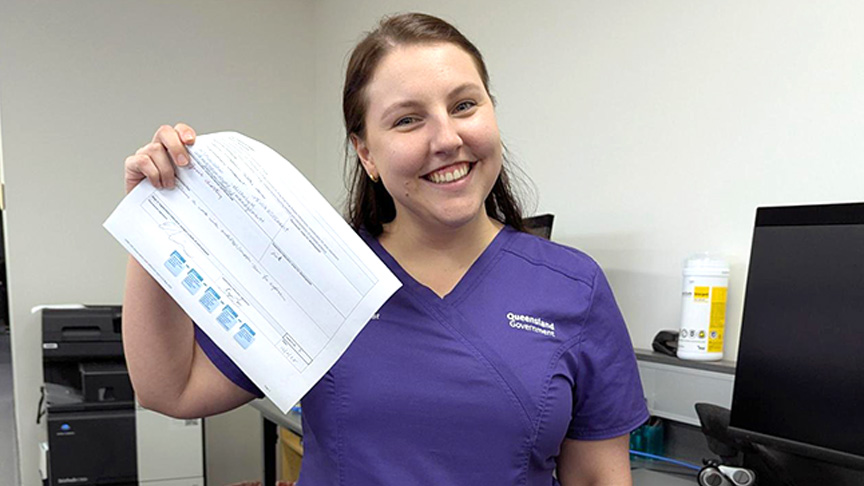
Specially trained pharmacists at Metro South Health (MSH) are now able to prescribe medications in partnership with doctors and nurse practitioners, under a new model designed to improve patient safety and support faster, more efficient care.
The Collaborative Pharmacist Medication Prescribing (CPMP) model was introduced in MSH in late 2025 and is being progressively rolled out across the health service.
Allied Health Principal Project Officer Courtney Hill said CPMP strengthens the way doctors, nurses, pharmacists and consumers work together to manage medicines.
“Under the model, an authorised pharmacist works with a medical officer or nurse practitioner as a ‘co-prescriber’,” she said.
“Together they review a patient’s medications and clinical needs, and agree on a management plan, in line with patient’s goals of care.”
“Once the clinical decision about a patient’s medication is made collaboratively, the pharmacist can prescribe according to that plan, which helps streamline care for patients”.
“This allows pharmacists to practise at the top of their scope while working alongside the multidisciplinary team.”
Legislative changes introduced in Queensland in April 2025 enable pharmacists working in hospital settings to undertake collaborative prescribing following completion of local training and authorisation.
Courtney said research has shown the model can reduce medication errors, particularly in the Emergency Department.
“It also contributes to improved patient flow, reduced length of stay and reduced cost of hospital admissions,” she said.
Pharmacists who participate in CPMP in MSH must complete a training program, followed by supervised practice with doctors or nurse practitioners at their local facility.
Courtney said MSH has taken a coordinated approach to implementing the model across its hospitals to ensure consistency and strong governance.
“We have worked with a wide range of stakeholders to develop an organisation-wide procedure, which provides the framework for CPMP across Metro South Health; each facility also has its own site-specific protocol.”
The program is already gaining momentum across the health service.
At Logan Hospital, 17 pharmacists have completed the training and have already supported the care of more than 1000 patients. Three pharmacists have completed the training at Princess Alexandra Hospital and around 30 pharmacists are currently progressing through the training at Princess Alexandra Hospital, with further cohorts underway at Bayside Health Service and QEII Hospital.
Courtney said feedback from clinicians involved in the program has been overwhelmingly positive.
“Doctors and nurse practitioners have been very supportive, and many are enjoying being involved in the training process,” she said.
“It’s a great example of multidisciplinary teamwork, and pharmacists have told us it’s professionally very fulfilling to contribute to patient care in this way.”