
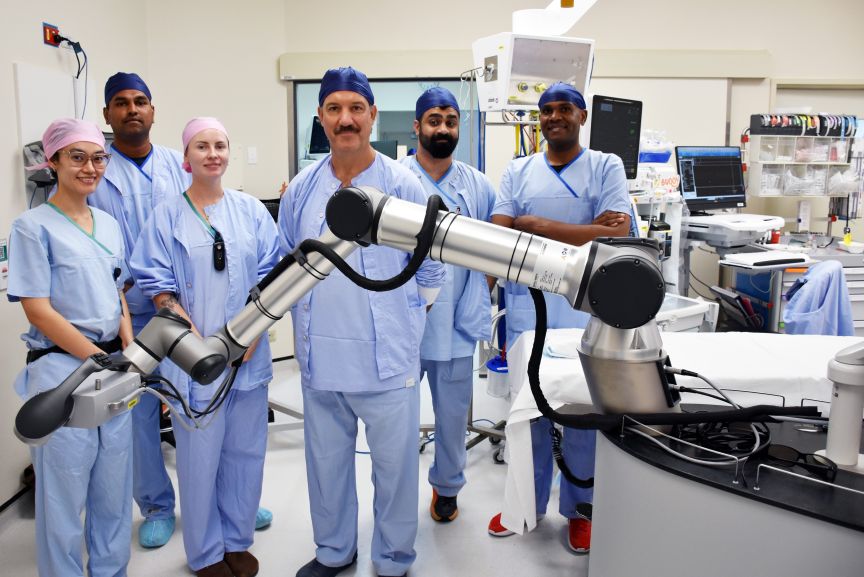
A Logan Hospital patient has become the first in Australia to undergo a panendoscopy using a new robotic visualisation system.
The milestone procedure was performed by Ear, Nose and Throat (ENT) surgeon Dr Simon Nasser using the VITOM® eagle system, which was released to the Australian market this year.
The exoscopic system is mounted on a robotic arm, allowing doctors to perform delicate procedures and investigations while viewing a high-definition digital image on a large screen.
“We previously used an operative microscope, which requires the surgeon’s body and head position to remain fixed in relation to the microscope,” Dr Nasser said.
“If we needed to move the microscope to see a different angle, we would physically have to shift our body.
“Using the robotic exoscope, we can now easily move the robotic arm to access more challenging views.
“The technology also offers enhanced imaging and fluorescence capabilities, allowing clinicians to see the surgical field in greater detail.”
The system also has the potential to reduce procedure times and improve collaboration and teaching in the theatre, according to Director of ENT A/Professor Bernard Whitfield, who supported its introduction at Logan Hospital.
“Being able to easily move the robotic arm minimises the time spent changing the visual perspective and the ability to view the procedure on a larger digital screen allows other clinicians to observe the surgical field and follow the surgeon’s work more easily” he said.
While the technology is being used by the ENT team, its flexibility could open the door to applications across other surgical specialties, including spinal surgery, hand surgery and vascular access breast reconstruction.
The milestone builds on Logan Hospital ENT’s track record of innovation, which includes Dial-a-Dizzy and the Complex Vestibular Service, that also celebrated an Australian-first in 2024 through a vertigo assessment of a young patient with a ventilator-dependent spinal cord injury.