
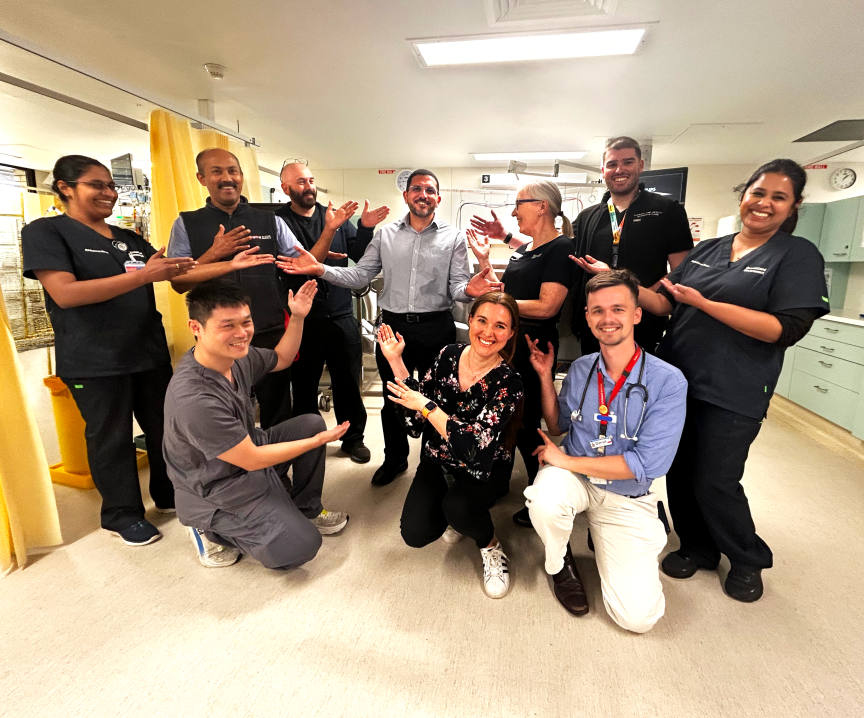
QEII Intensive Care Unit Consultant, Dr Ahmad Nasser, is improving ICU patient outcomes across Queensland with his research in hypernatremia.
His paper, ICU-acquired hypernatremia: Prevalence, patient characteristics, trajectory, risk factors and outcomes, won the Inaugural Rinaldo Bellomo award at the Annual Scientific Meeting held by the College of Intensive Care Medicine.
Hypernatremia is a high concentration of sodium in the blood and can cause dangerous complications for critically ill patients.
"We noticed some inconsistencies in the timing and definitions used in the current literature for hypernatremia," Dr Nasser said.
"Due to those inconsistencies, we realised that the studies were limited and may not fully represent the broader ICU population."
"Furthermore, we weren’t sure whether patients who develop new hypernatremia after ICU admission have better or worse outcomes than other patients."
Dr Nasser, together with a team of researchers, and in collaboration with the Queensland Critical Care Research network, collected data from more than 55,000 ICU patients across Queensland.
The study was conducted over a 7 year period, providing a near complete representation of the ICU population.
"We found that 7.5 per cent of ICU patients develop new hypernatremia, which is a significant proportion of our patients."
"We also found that these patients face a higher risk of in-hospital mortality than others, giving the research community and Australian ICUs a strong incentive to address this problem."
QEII ICU, along with five other intensive care units across Australia and New Zealand, trialled a new treatment approach for hypernatremia based on the research.
The new treatment protocol is now being implemented in these ICUs.
"I find it deeply rewarding to have the opportunity to identify factors that may put our patients at risk and to help develop treatment protocols to address them."
"Working to reduce risks and improve patient outcomes is the motivating factor for me."
Dr Nasser’s award-winning research is helping shape better care for critically ill patients, with the potential to improve outcomes for thousands of people across Queensland and beyond.