
Summary
PAH has a 40-year history as a home of leading hypopharyngeal cancer surgery.
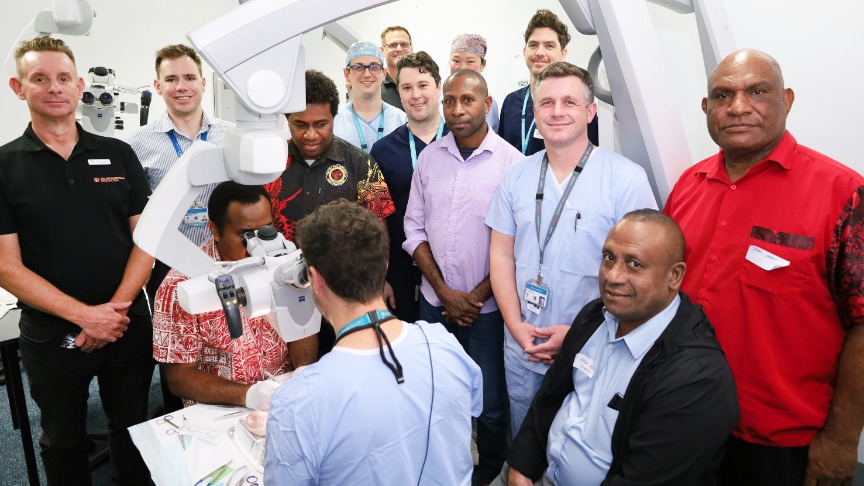
A microvascular head and neck reconstruction workshop was hosted in June for surgical trainees from Papua New Guinea.
Princess Alexandra Hospital hosted a Microvascular head and neck reconstruction workshop in June for surgical trainees from Papua New Guinea enabling them to tackle the growing burden of oral cavity cancer.
PA Hospital Microvascular reconstructive surgeon, Dr Robert Calvisi said PA has a 40-year history as a home of leading hypopharyngeal cancer surgery and a strong legacy of collaboration between Plastic surgeons and ENT surgeons who care for these complex cancer patients.
“While surgical approaches have changed, PA Hospital’s reputation in specialist surgery – in particular microsurgery techniques - continues to bring trainees from throughout the Pacific for training from our leading Plastic and Reconstructive surgeons and ENT surgeons,” Dr Calvisi said.
“PAH has fostered 15 surgeons from Port Moresby through the ENT specialty since the 2000’s and that support will continue to upskill the 10 working surgeons, six training registrars, and additional trainees from Solomon Islands, Tonga and Vanuatu.
“After a training tour to PNG earlier this year, we were pleased to host this latest workshop at PAH and The University of Queensland lab providing focussed solutions for treatment of mouth cancer using microsurgery and other leading head and neck surgery techniques.”
Chief ENT surgeon for PNG, Dr James Naipao said skills development of the trainees was fundamental to advancing the country’s ability to manage the growing demand for this type of surgery with a population estimated at 16 million.
“Every surgical clinic we are seeing about 10 patients; of these seven or eight of them are cancer patients. On top of that, most are presenting with Stage 3 and 4 cancers and require multiple modalities of treatment from surgery to radiation,” Dr Naipao said.
PNG communities have a history of chewing betel nut and smoking which is linked with cancers of the throat; but many young people who do not participate in this activity are developing these cancers.
The most common cause of cancer in PNG is cervical cancer in women. The second most common cancer is non-smoking upper airway cancer – mostly mouth but also back of the throat often requiring a laryngectomy which particularly affects younger non-smoking women.
“Surgery is such an important part of what we need to do for these patients,” Dr Naipao said. “Training and upskilling is vital to meet these needs and PA is the best place for us to do that.”
The June workshop included a microsurgery training session at PAH hosted by the Plastic and Reconstructive surgery department and a hands-on anatomy training workshop at UQ for six surgeons including trainees and their leadership team.
The Passe & Williams Foundation provided financial contribution of $35,000 for the workshop at PAH and UQ. The Foundation supports excellence in ENT by advancing ear, nose and throat research, surgery and care.
Next year, full surgical training will be offered for trainees from more countries in the Asia-Pacific covering a population of 25 million.
The workshop was thanks to:
- Passe & Williams Foundation for the funding to undertake the training at PAH/UQ.
- PA Hospital Ear, Nose and Throat Unit, Plastic and Reconstructive surgery Unit and The University of Queensland for hosting
- Surgeons Dr Robert Calvisi (PAH), Dr Campbell Schmidt (RBWH), Dr Roger Grigg (Toowoomba), and Dr Chris Perry (PAH)
- 'Microsurgical Specialties’ who offered their time and loan equipment
- Aboriginal Liaison officer for Australian Society of Otolaryngology Head and Neck Surgery, Angela Scotney, who champions empowerment.