
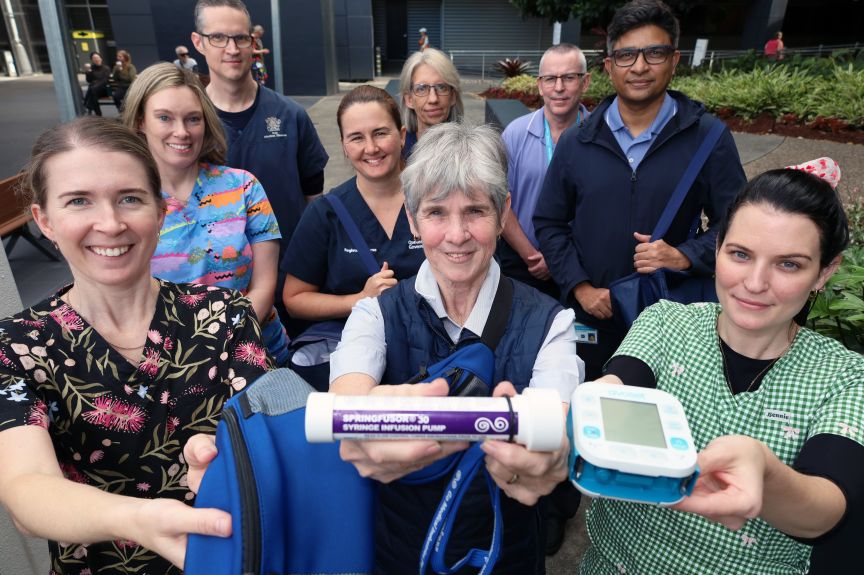
Acute Care @ Home PA Hub are opening more doors with creative solutions for patients to receive care outside of hospital.
This team delivers high-quality care in patients’ homes by adapting hospital-level care to a community setting.
Without the infrastructure and support systems of a traditional inpatient environment, they rely on innovation, collaboration and creative problem-solving to ensure patients receive the care they need while remaining out of hospital.
Nurse Unit Manager of Acute Care @ Home PA Hub, Erin Dunne said their crew of 15-18 clinicians are committed to providing care options outside of the traditional inpatient setting.
“Our aim is to improve the patient experience, support earlier discharge, prevent unnecessary admissions and optimise hospital capacity,” she said.
A pull strategy means this vital service empowers inpatient teams to engage early in a patient’s discharge planning.
“Early identification allows our team to assess patient suitability and coordinate the necessary community supports for a more streamlined transfer of care out of an inpatient bed,” Erin said.
“Our presence on wards and at MDT meetings reinforces AC@H as a solution for both inpatient and outpatient models of care – particularly our key services of Hospital in the Home, Alternative Site Infusion Service, and Post-Acute Care Service.”
She said the team is innovating new models of care while continuing to strengthen the legacy services that have long-delivered outstanding patient outcomes.
One of these is the Alternative Site Infusion Service (ASIS) – a coordinated and flexible outpatient service for patients requiring long-term antimicrobial therapy.
“We are expanding the range of patients who can safely receive hospital-level care at home through the establishment of a multidisciplinary Hospital in the Home model known as HITH+ in partnership with our allied health colleagues.
“Strengthened partnerships across divisions will be the key to expansion,” she said. “Increasing our in-hospital presence and more informed service planning will mean we can understand and deliver what they need from community services.”
The numbers show the pathways are working with the 2025 to 2026 financial year to-date showing
- HITH – inpatient: 693 patients | 3795 occasions of service
- ASIS – outpatient: 313 patients | 2396 occasions of service
- PACS – Outpatient: 135 patients | 832 occasions of service
Aside from growing innovative models that advance the needs of PAH to maximise bed availability, the team are taking up the challenge to meet patients’ needs in a way that is meaningful to them.
“We are undoing some of the historic views around the limitations of care that can be provided at home and focussing on building a service that ‘will find a way’,” Erin said.
“We also take extraordinary delight in reuniting patients with their pets – there is the added benefit of a puppy cuddle for our team too which is a terrific perk of the job.”