
Summary
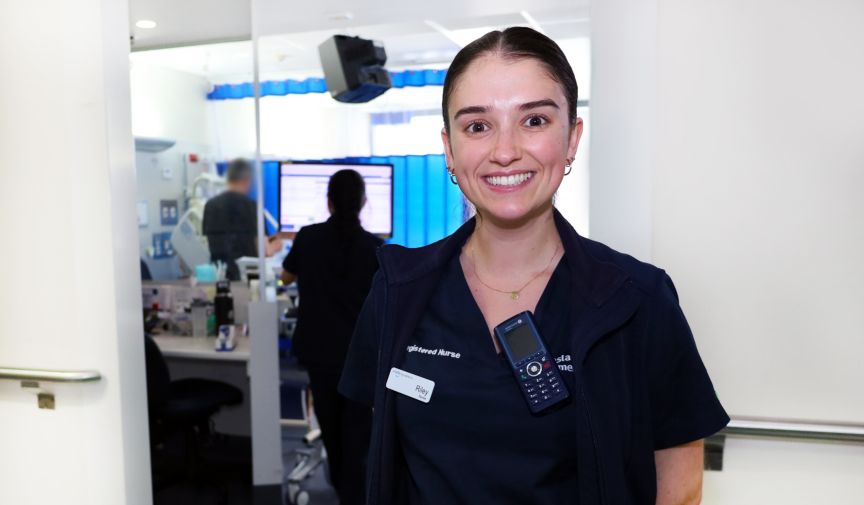
Riley is a Stroke Access Clinical Nurse as part of PA Hospital’s stroke team.
PAH is recognised internationally with the most WSO Angels Awards of any hospital in Queensland for delivering world-class stroke care.
No two days are the same for Riley Clarke who is passionate about caring for stroke patients and supporting loved ones throughout their time in hospital.
"A big part of my role is educating patients and their families. It can be extremely overwhelming from the minute they arrive in emergency and are admitted under the stroke team,” she said.
Riley has built her career at PA Hospital, beginning as an undergraduate student working across the Internal Medicine Unit before securing her graduate registered nurse position on Ward 5B.
"I just found that stroke was something I was really interested in."
Since then, she's taken on a variety of roles within the unit and now works as the Stroke Access Clinical Nurse.
"For me, the most rewarding thing is being able to connect with people who are going through a really difficult time in their lives," she said.
"Every day, you see people make small improvements and you're able to come back and celebrate those little wins with them and their families."
Riley is one of the dedicated staff members who make up PAH’s highly regarded stroke team, recognised internationally for delivering world-class stroke care.
The team has an unwavering commitment to continuous improvement, which has been recognised by receiving six World Stroke Organisation (WSO) Angels Awards over the past 18 months - two Platinum and two Gold in 2025, and two Gold in 2026.
PAH also holds the distinction of having the most WSO Angels Awards of any hospital in Queensland.
Riley said the achievements reflect a collective effort across multiple teams.
"Everyone shares a common goal because we all want better outcomes for these patients and their families," she said.
National Stroke Week is held from 3 – 9 August 2026 with this year's theme highlighting F.A.S.T. heroes, the people who recognise the signs of stroke and call an ambulance immediately, potentially saving a life.
Riley said knowing the signs of stroke and acting quickly can make a huge difference.
"The message every year is ensuring people are able to identify the signs and symptoms of a stroke using the F.A.S.T. acronym," she said.
"Recognise if someone has a facial droop, whether they can lift both arms or if one arm is weaker than the other, and if they've had changes in their speech.
"If you notice any of those signs, the most important thing is getting people to hospital in a timely manner so that we're able to provide acute treatment and ultimately achieve better outcomes."
For more information about National Stroke Week and the F.A.S.T. campaign, visit the Stroke Foundation website.