
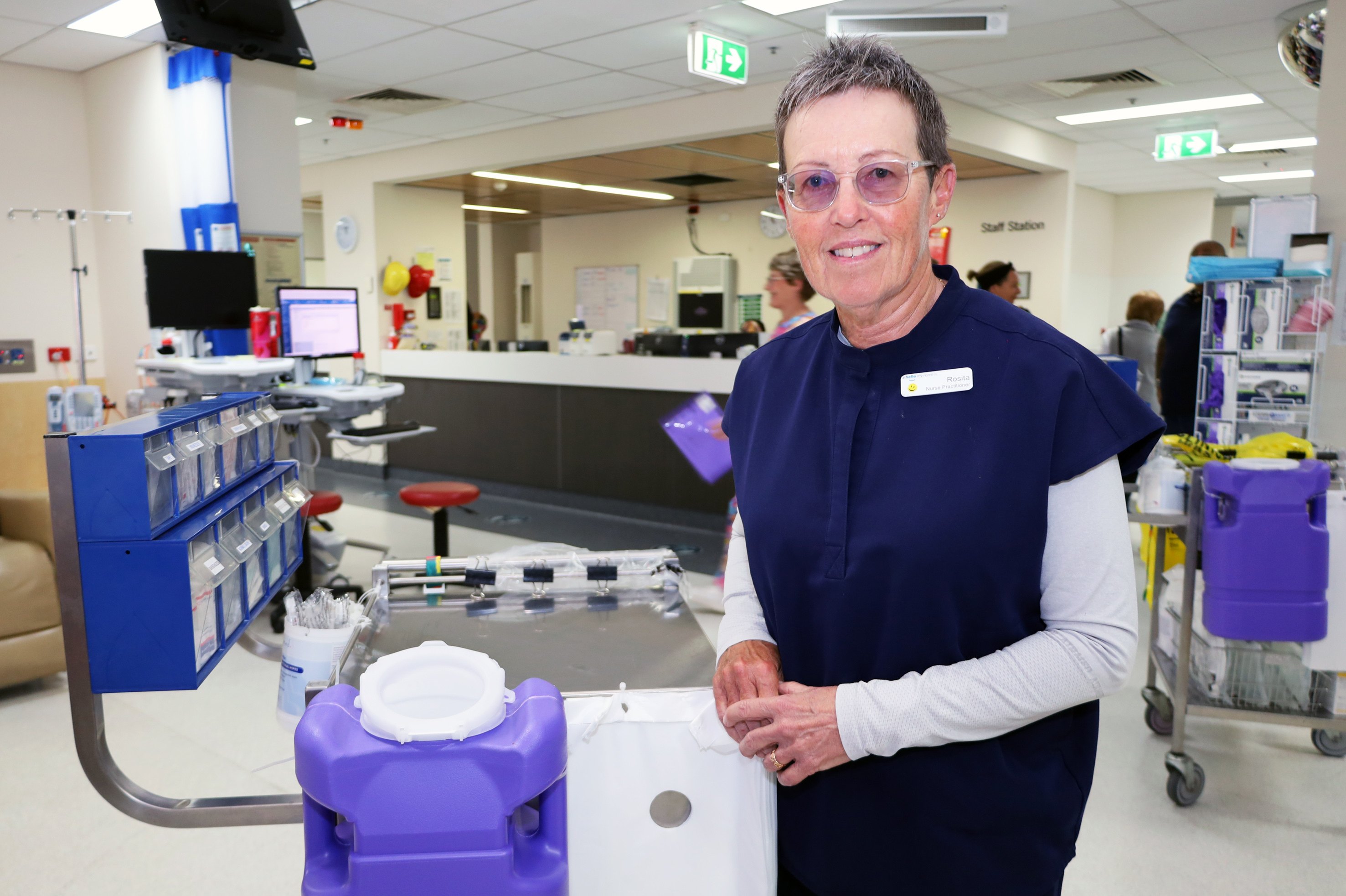
Queensland’s first Nurse Practitioner for Haematology Stem Cell Transplantation, Rosita Van Kuilenburg has dedicated her career to advanced practice nursing in cancer care at Princess Alexandra Hospital.
For almost 50 years, she has influenced the lives of countless patients and infused nurses with her professionalism and knowledge.
It is this privilege of teaching nurses about the profession as well as specialty nursing in haematology that brings emotion to the fore and Rosita describes it as the honour of her career.
“One of the things I hold dear is the development of the nursing staff and the one-on-one learning opportunities over the years.
“The change in practice within cancer care has grown exponentially since I started at PA Hospital,” she said. “Even though it is complex treatment, you need to practice the basics consistently and I have loved this aspect of nursing training.
“My ethos is if you don’t learn something every day, why are you here? And you should absolutely enjoy what you do!” Rosita said.
After working as a psych and general ward nurse at PAH in the 80’s, Rosita’s pathway through cancer nursing at PAH led her to the stem cell transplant team at RBWH before a grant to study transplant overseas changed the trajectory of her career in the specialty.
“What started with a picture in a textbook of a laminar flow isolation bed for the protection of leukemic patients, led to decades of upskilling before my role in designing and developing Queensland’s first purpose-built haematology transplant unit at the Wesley Hospital which was a significant collaborative achievement,” Rosita said.
This new partnership approach across medical and nursing established the need for an advanced practice nurse and Rosita received the tap on the shoulder in 2003 resulting in her becoming the first NP in Queensland for Haematology Stem Cell Transplantation.
From this time, PAH led an evolution in cancer care.
“PA were pioneers transitioning inpatient treatment to an outpatient model,” Rosita said. “From there we championed new treatment protocols, home-based treatment options and also patient autonomy with self-care.
“One of the major steps forward was transitioning nursing staff to undertake PICC insertion instead of Radiology which was a huge improvement in efficiency for the patients as well as our service.”
The introduction of intravenous lines for stem cell reinfusion was an improvement that Rosita brought to PAH from private practice and her work with policy and standard development interstate changed the way chemotherapy is delivered across both public and private practice.
Reflecting on her 23-year journey in advanced practice nursing, Rosita said it is impossible to find just one memory that she holds dear.
“Every patient interaction is special – they have all been a privilege to care for,” she said. “And the people I work with inspire me and others every day.”
Rosita cell-ebrated her retirement from PAH in April with colleagues across nursing and the haematology specialty offering heartfelt wishes on the transplant into her retiree era.