
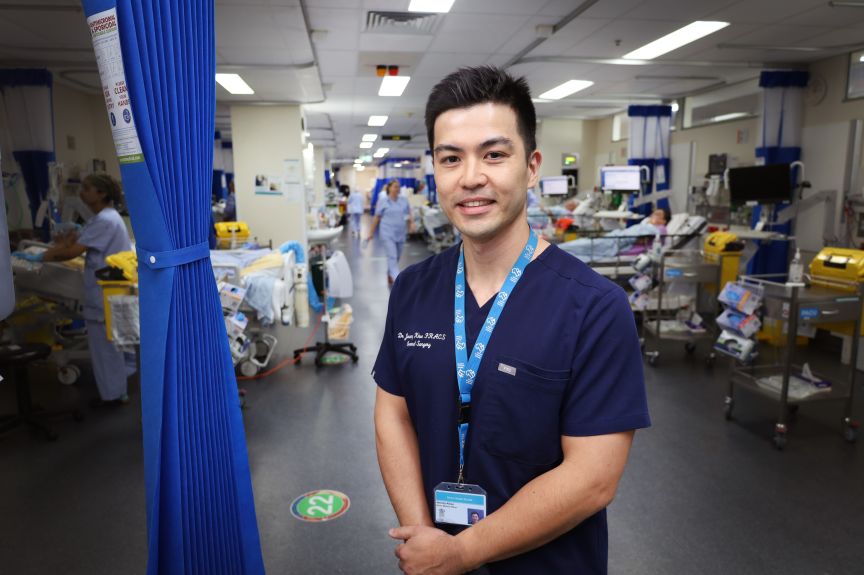
The first endoscopic nipple sparing mastectomy with immediate implant reconstruction in Queensland was undertaken at Princess Alexandra Hospital in July.
The minimally invasive technique will benefit a subset of the 250 to 300 women who are treated for breast cancer at PAH each year.
Breast and Endocrine surgeon, Dr Jeremy Khoo, said the benefits of this procedure are both oncologic and cosmetic with the added bonus of a shorter recovery time.
“The procedure can be achieved with a 3-4 centimetre incision placed away from the breast and enables us to do a full implant or autologous reconstruction using the same incision,” Dr Khoo said.
“This technique enables excellent, magnified visualisation using a high-definition camera during the surgery but also enables the patient to recover much more quickly thanks to the small incision, compared to incisions two-to-three times longer used in the traditional open surgical technique.”
Breast Cancer surgery is one of the few general surgery sub specialties where cosmesis is as important as the oncological outcomes.
“As expected with a minimally invasive procedure, recovery is much quicker, it also reduces the cosmetic impact of breast cancer surgery,” he said. “It uses equipment and techniques that we already have available for other laparoscopic general surgeries to effectively do a better operation.”
Additional benefits include reduced post operative pain with less tissue disruption, halved hospital stay of one-to-two days, and halved return to activity within two-to-four weeks instead of four-to-eight weeks.
It also reduces risks such as surgical site infections or neurovascular compromise of the skin flaps and nipple-areolar-complexes which are more commonly associated with the traditional open technique.
Dr Khoo said while this technique is not new, we are pleased to offer it for the first time in Queensland.
“This procedure provides oncologically safe mastectomy for women with diagnosed breast cancer or those who are at high risk of breast cancer who choose prophylactic risk reducing mastectomies.
“It has been used successfully in Taiwan, Korea, Singapore and some others, mainly because of the suitable anatomy of Asian women who tend to have smaller breasts on average,” Dr Khoo said.
He said this technique does not replace conventional open breast surgery as it does not suit every patient whether that be for treating breast cancer or risk reduction.