
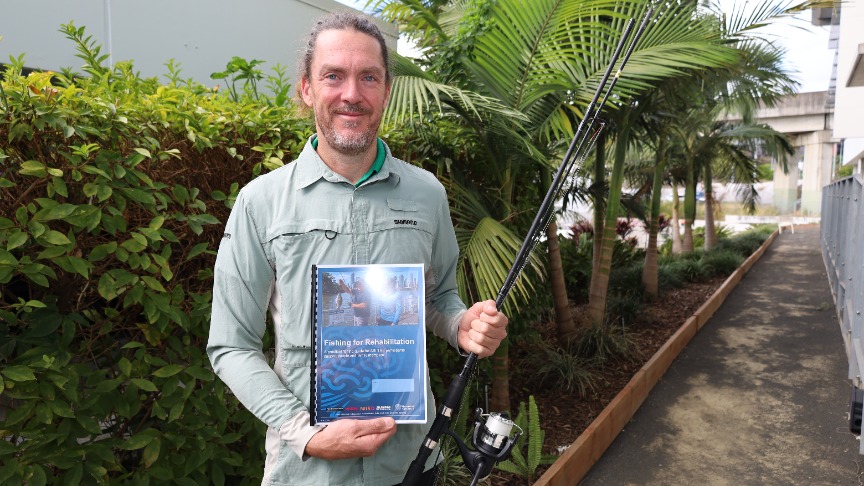
Fishing therapy is making a splash at the Acquired Brain Injury Transitional Rehabilitation Service (ABI TRS), thanks to an allied health-led initiative.
First trialled by Allied Health Assistant Aaron Arthur in 2023, the Fishing for Rehabilitation project enhances social engagement, wellbeing, and rehabilitation outcomes for participants navigating life after an acquired brain injury.
“We had some participants who were finding it difficult to engage in traditional rehab therapies, and one of them was interested in fishing. Our goal is to get people back to their hobbies and interests, so we took them fishing. We had really positive outcomes for that client, so we kept rolling with it.”
Three years and 34 participants later, the idea evolved into a team project that would enable formal implementation, with support from a Hopkins Centre Bright Sparks Grant.
"The project allowed us to review the benefits of fishing, create procedures and referral processes, as well as having something that we could leave with support workers and families to help people continue fishing after the program because the benefits were so great,” Aaron explained.
The benefits included improvements in mood, social interaction, confidence, functional skills and increased rehabilitation engagement.
“The program has had massive benefits, because fishing creates a neutral environment with exposure to nature where people can participate in rehabilitation therapy and open up and talk about things that they didn't feel comfortable talking about in a therapeutic space in the hospital, or even in their homes,” Aaron explained.
“It’s effective because it doesn’t feel like work. It doesn’t feel like therapy. Participants are learning new skills and having success catching fish, while working on their rehabilitation goals.”
Importantly, the Fishing for Rehabilitation guide booklet empowers participants, their families and their carers to continue fishing long after completing the 10-week program.
“Our aim was to create a simple how-to guide, so anyone would be able to continue on and take people fishing, even if you have no knowledge of fishing, you should be able to pick the book up and be able to tie a knot, learn how to cast a rod, all that sort of stuff.”
Through rain, hail and shine, the addition of a virtual reality (VR) fishing experience ensures no one misses out.
“We found that participants were so excited about their fishing sessions, that it was a really big letdown if the weather didn’t allow it, or if someone got sick. As part of the project, we developed a VR fishing component, so if it’s raining or it’s too hot outside, we can take the VR headsets out to the participant’s house and do virtual reality fishing,” Aaron said.