
A world-first biosecurity initiative to combat invasive mosquitoes will be launched in the Metro South region, thanks to a $1.33 million National Health and Medical Research Council (NHMRC) Ideas Grant.
Commencing in 2026, the PORTS project – Precision Optimisation for Resilient Targeted Surveillance – will bring together researchers, government and community members to develop a framework that will help prevent the risk of invasive mosquito species bringing exotic diseases into Australia.
The project is being led by Gordana Rasic of QIMR Berghofer Medical Research Institute, Brian Montgomery of Metro South Health, and John Marshall of University of California, Berkeley.
Residents in the Metro South region are invited to participate as citizen scientists, to monitor local mosquito populations in their own backyards.
Gordana Rasic said the project hopes to provide a novel tool to prevent exotic mosquito species being able to invade our suburbs should they escape from international seaports or airports.
To do this, local mozzies will be collected and linked to state-of-the-art mosquito population genomics and simulation-based spatial modelling.
“PORTS will use genomic analysis of mosquitoes trapped by citizen scientists to generate suburb-level risk and identify target areas,” Gordana said.
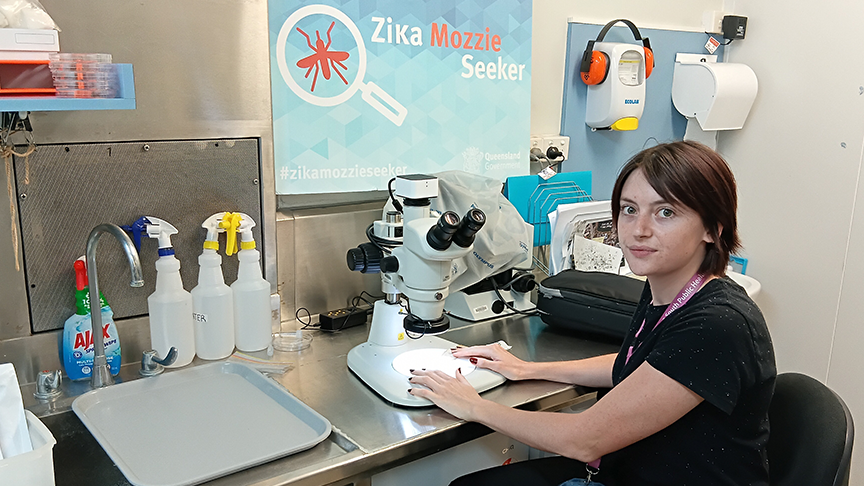
The project builds on the success of Metro South Health’s two existing mosquito surveillance programs – the RSVP Network and the Zika Mozzie Seeker (ZMS) citizen science initiative.
Brian Montgomery said strong community participation would be critical.
“The more people who sign up, the more powerful this surveillance network becomes,” he said.
PORTS will compare the genomics of two urban mosquito species that breed in containers that hold water – ‘the Australian backyard mosquito’ (Aedes notoscriptus) and ‘the brown house mosquito’ (Culex quinquefasciatus) – collected near the Port of Brisbane and Metro South suburbs within a 15km radius including Wynnum, Manly, Lota and Hemmant.
Joining the team will be postgraduate researcher Ellie Lindert who will be reaching out to local communities, testing mosquito trap designs, and learning genomic methods.
“We want to identify if, how, and where, the local mosquitoes inside and outside the biosecurity zones are connected,” Brian said.
“If we can break the connections in populations of the local urban mozzie, we hope to also reduce the risk of Zika mozzies (Aedes aegypti and Aedes albopictus) invading the region and prevent future outbreaks of Zika, Dengue, or Chikungunya.”
The first step for PORTS is to identify the areas and suburbs in the Metro South region that are at high-risk of invasion, using ZMS.
“Importantly, the project will also develop and field-test new trap designs for participants to use in their own backyards for the brown house mozzie, a type of urban mosquito not currently collected by ZMS traps,” Brian said.
“We are hoping to see if citizen scientists can suppress local urban mosquitoes using the new traps as this will help reduce the chances that exotic mosquitoes will survive escape from Australia’s international airports and seaports.”
By combining advanced genomics, modelling and citizen science, PORTS aims to deliver long-term protection for the Metro South community.
“PORTS opens the door to scalable, community-driven control of urban mosquitoes as a practical tool to detect and contain public health threats by invasive mosquitoes earlier than ever before,” Brian said.
Metro South residents interested in becoming citizen scientists and contributing to this world-first research project can sign up here.