
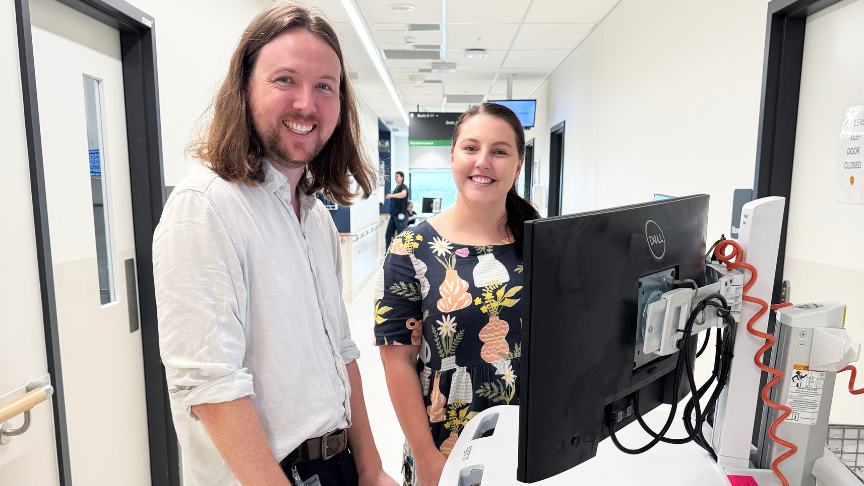
Emma Gislingham and Matt Gibbs are two of 17 specially trained pharmacists at Logan Hospital who can now prescribe medications in partnership with doctors and nurse practitioners.
The Collaborative Pharmacist Medication Prescribing (CPMP) model was introduced at Logan and Beaudesert Health Service (LBHS) in late 2025 and is now being rolled out across Metro South Health.
Emma and Matt have been involved in the program since it was piloted at Logan Hospital in 2023, both drawn to the opportunity to work at the top of their scope while providing a more patient-centred model of care.
Senior Pharmacist Emma said she had wanted to be involved in CPMP, or a similar collaborative model, since becoming a hospital pharmacist. She believes the CPMP represents a transformed way of thinking about collaboration in the hospital setting.
“Collaboration, rapport building, and patient centred care has driven me to come to work since I was an intern pharmacist,” she said.
“In healthcare, we have to keep dreaming big and striving for a new way to deliver care for our consumers, especially with an aging population, cultural diversity, and geographic growth in directorates.
“Working at the top of my scope, being involved in decision making, collaborating, putting the patient at the forefront of care, involving our profession earlier in the patient’s journey, providing evidence based recommendations are all reasons the CPMP model benefits our patients, the pharmacy profession, the organisation and healthcare.”
Pharmacist and Advanced Team Leader Matt said he found genuine joy in improving the lives of patients and their families, and that working as a CPMP pharmacist has allowed him to have a greater and more meaningful impact on safe, high quality care.
“I truly enjoy reading clinical trials and applying evidence-based medicine. I find great satisfaction in investigating the causes behind a patient’s presentation to hospital and in optimising their medication therapy,” he said.
“Working as a CPMP pharmacist has allowed me to engage even more closely with admitting teams. This collaboration with medical and nursing colleagues enables us to identify, discuss, and resolve medication related adverse events together.
“It also allows us to provide patient centred, evidence-based optimisation of medication regimens. This combination of clinical problem solving, teamwork, and meaningful impact on patient care is what drives me every day.”