
Laughter in the Emergency Department (ED) may be rare, but for 100-year-old Norma Heise, a simple conversation with a Skywalker volunteer brought just that.
Despite feeling unwell, Norma was seen smiling, laughing and chatting with the volunteer, an interaction that clearly lifted her spirits in what can be a daunting environment for older patients.
Specially trained Skywalker volunteers have been supporting geriatric services in Logan Hospital’s ED since 2023, with the initiative gaining attention for how it addressed the emotional and practical needs of older patients in a high-pressure clinical setting.
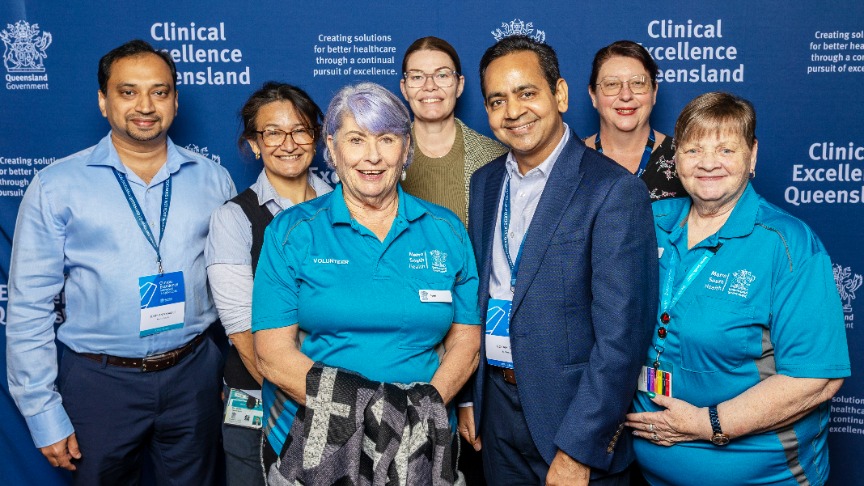
Geriatrician Dr Golam Sarwar recently presented the program’s impact, using Norma’s story, at both the LBHS Research Symposium and the Clinical Excellence Showcase, following its recent nomination for an award.
An initiative of Logan Hospital’s Geriatric Emergency Department Intervention (GEDI) team, the Skywalker Volunteer Program aims to provide compassionate, non-clinical support to older patients during their time in the ED.
Dr Sarwar said Norma’s interaction reflected the essence of the program he pioneered and was just one of many similar stories.
“Norma’s experience shows us how meaningful human connection can be as therapeutic as medicine,” he said. “Older patients often face longer ED stays due to complex health issues and can become overwhelmed by the fast-paced, often chaotic emergency department environment.
“While clinical staff focus on urgent medical care, many older patients need something just as vital - a calm presence, conversation and reassurance.”
Skywalker volunteers receive specialised training to provide exactly this kind of support, offering companionship, assisting with hydration and nutrition, and helping patients feel more at ease.
Dr Sarwar said these small acts of kindness had made a measurable difference.
Patient survey data collected between the program’s launch and December 2024 showed a significant improvement in patient experience.
“Before Skywalker, 42.9 per cent of older patients rated their non-clinical care in ED as ‘poor’ or ‘fair.’ Post-implementation, this number dropped to just 3.2 per cent, while 76.2 per cent rated their experience as ‘very good’ or ‘excellent',” Dr Sarwar said.
While early outcomes are promising, Dr Sarwar said there was potential for the program to deliver broader health benefits.
“We believe Skywalker may also contribute to reducing rates of delirium and other hospital-acquired complications in older patients. We’re looking forward to exploring this further through future research,” he said.
For patients like Norma, the program’s value is already clear, offering a reassuring presence and a moment of connection in a time of uncertainty.