
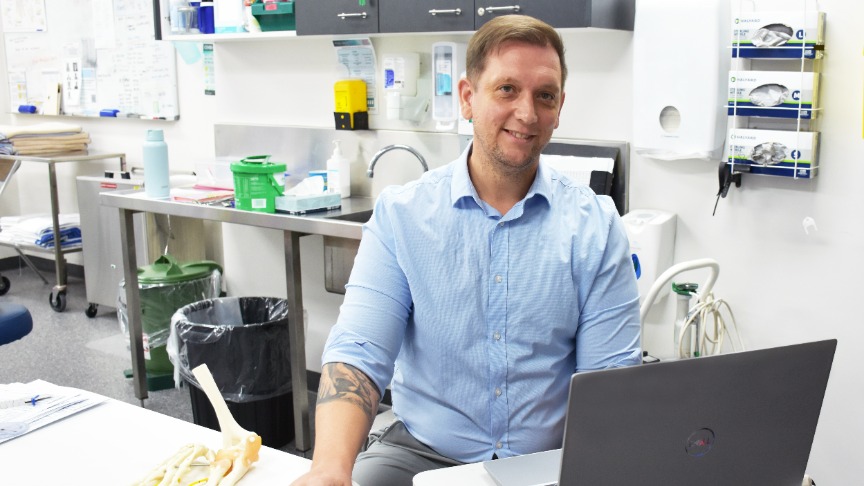
Nearly a decade of innovation in hand trauma care at Logan Hospital has been formally recognised with the publication of a new research paper.
The paper, Advanced Practice Hand Therapy Management of Fracture Clinic Referrals: A Retrospective Cohort Study, highlights the impact of an allied health-led Advanced Practice Hand Clinic (APHC) in managing acute upper limb trauma.
Advanced Physiotherapist Christopher Burton has played a leading role in developing and expanding the APHC since 2017.
Designed to support patients with stable or low-risk injuries, the clinic provides an alternative care pathway, with eligible patients seen in the APHC in lieu of orthopaedic referral, allowing rehabilitation to begin earlier.
While the clinic had been operating successfully for several years, Christopher said he made the decision a few years ago to formally evaluate and publish the work, given the limited literature in this area.
“With ethical approval and data collection underway, a 2025 research grant provided the dedicated time and support needed to analyse the data, complete the paper and share our findings,” he said.
The APHC is led by experienced hand therapists working in advanced practice roles across physiotherapy and occupational therapy, with clear pathways for escalation to Orthopaedics when required.
“The success of the clinic is strengthened by strong collaboration across Orthopaedics, Physiotherapy and Occupational Therapy,” Christopher said.
Supported by the research grant, Christopher has since presented the findings to an international audience, showcasing Logan Hospital’s model of care and its potential to inform allied health-led services more broadly.
Importantly, the APHC is not a standalone success story.
It is part of a broader commitment to research, evaluation, and continuous improvement across Allied Health, in partnership with our wider healthcare team, supported through the Allied Health Research & Quality Improvement (AH R&QI) Initiative.
Acting Director of Allied Health, Carina Hartley, said the AH R&QI Initiative was created in 2025 to give clinicians the support needed to examine how care was delivered and to improve it in meaningful ways.
“By enabling Allied Health staff to lead research and quality improvement projects grounded in real patient experience, the Initiative helps turn frontline insights into safer, more effective, and more person-centred services.”
Last year six projects were supported through the Initiative, each focused on improving access, strengthening care pathways and ensuring treatment was based on evidence and local need.
“For patients, this means care that is more responsive, better coordinated, and easier to navigate. For clinicians, it builds confidence and capability to lead change. For the health service, it supports smarter use of resources while maintaining a strong focus on quality and safety,” Carina said.