
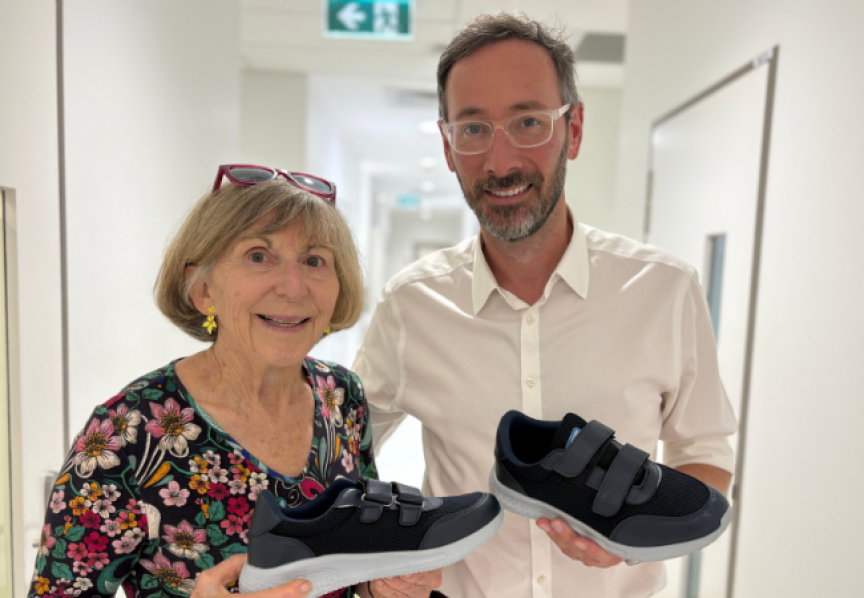
When Jenny Staib goes for a walk, her new shoes will do more than get her from A to B.
Her trainers are packed with sensors that record how she walks, helping clinicians track changes in balance, mobility and falls risk caused by Parkinson's disease.
Jenny is one of the first participants in a study at Bayside Health Service's Movement Disorders Clinic at Wynnum Manly Community Health Centre.
The research lets patients take part closer to home, reducing travel to major hospitals and helping researchers develop ways to monitor symptoms during daily life.
Diagnosed with Parkinson's several years ago, Jenny said the news had been difficult.
"Even though it is shattering, it's not the end of the world," Jenny said. "It's hard at times, but if you pull yourself up by the boot laces and look outside, nothing has really changed from yesterday.
"The world is still beautiful, and you can still be happy, find new things and live fully."
Staying active has become central to managing her condition.
"Exercise is so important, whether you have Parkinson's or not," she said. "My friend Jane and I spent two weeks cycling around Japan, riding more than 500 kilometres and having a tremendous amount of fun.
"Feeling fit and supported has made a huge difference to my Parkinson's journey."
PA Hospital Neurologist Dr Alexander Lehn said the trial is investigating whether smart shoes can provide more accurate, real-world information about movement.
"The shoes look like trainers, but are packed with technology that measures stride length, walking speed, heel lift and gait changes," Dr Lehn said. "They also provide gentle vibration, or haptic feedback, which may help people manage symptoms such as shuffling, freezing of gait and balance problems.
"Rather than relying only on clinic visits, the shoes collect information during daily life, giving us a clearer picture of mobility.
"Bringing clinical research to Wynnum makes it easier for people to participate and helps shape the future of Parkinson's care."
Dr Lehn said the study reflected a commitment to ensuring people living with Parkinson's disease could access leading research and specialist care without having to leave their local community.
"If successful, this technology could help us better monitor Parkinson's, especially for people in rural communities with less specialist care."
Neurologist Dr Dafydd Llewelyn said the Movement Disorders Clinic supported patients throughout the study.
"We assess patients, monitor symptoms, walking ability and quality of life throughout the trial," Dr Llewelyn said. "Research like this lets our patients access emerging technologies and helps us improve care."
Patients are supported throughout the trial by a multidisciplinary team including neurologists, physiotherapists, nurse navigators, researchers, and allied health professionals.
Research Coordinator Schible Kurian said clinical trials in community settings meant more people could participate without travelling to larger hospitals.
For Jenny, taking part in the study is about giving back. Every step she takes in her smart shoes is helping researchers build a better understanding of Parkinson's disease and contributing to future care for others living with the condition.