
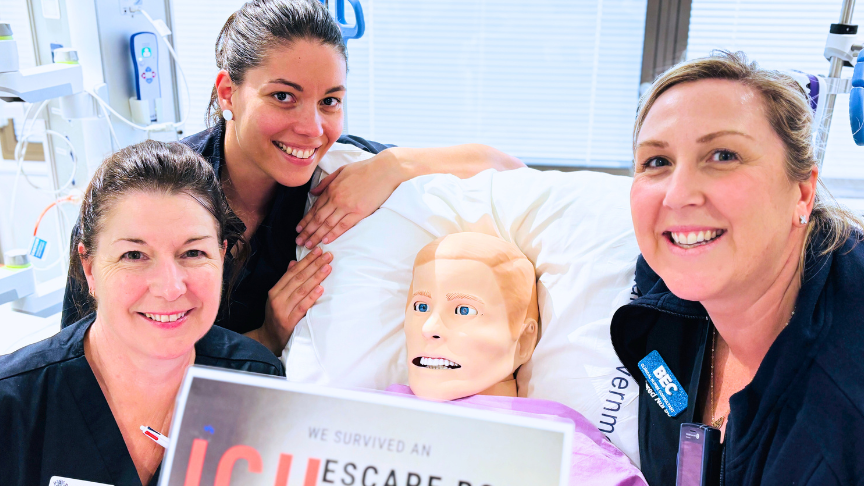
As Redland Hopsital's new ICU prepares to open later this year, staff have been working with “Handsome George”, a high-tech training mannequin, and trialling an escape room simulation to build teamwork, communication, and resilience under pressure.
Instead of darkened rooms with padlocks and riddles, these simulations put staff through high-stakes clinical scenarios such as anaphylaxis - a severe, potentially life-threatening allergic reaction, requiring them to solve problems step by step to “escape”.
ICU Nurse Educator Ebony Lawrie said the approach had been a hit with staff.
“It might sound unusual but escape room simulations are a fantastic way to build team culture,” she said. “Handsome George can scream, cough, make lung sounds such as wheezing and simulate an airway obstruction. We can also drop his heart rate, change his blood pressure and even dilate his pupils.
"Teams have to work together under pressure, communicate clearly, and you can’t skip a step or cut corners."
Ebony said the simulations improved stress management and resilience because the escape room simulated time pressure and cognitive load of real clinical crisis in a safe space.
"It’s a fun way to learn, but also a really powerful way to reinforce hospital protocols in a safe space.”
The benefits of escape room simulations go beyond teamwork.
The Bayside Executive Leadership Team recently took part in an anaphylaxis escape room challenge with Executive Director Greg Nolan describing the simulation as eye-opening.
“It was great fun, but also a serious reminder of how complex clinical teamwork can be," he said.
"The simulation really brought home the importance of clear communication. That if you miss something, the whole team feels it. It’s exactly the type of training that will help build a strong, focused and high-performing team when we open the ICU later this year.”