
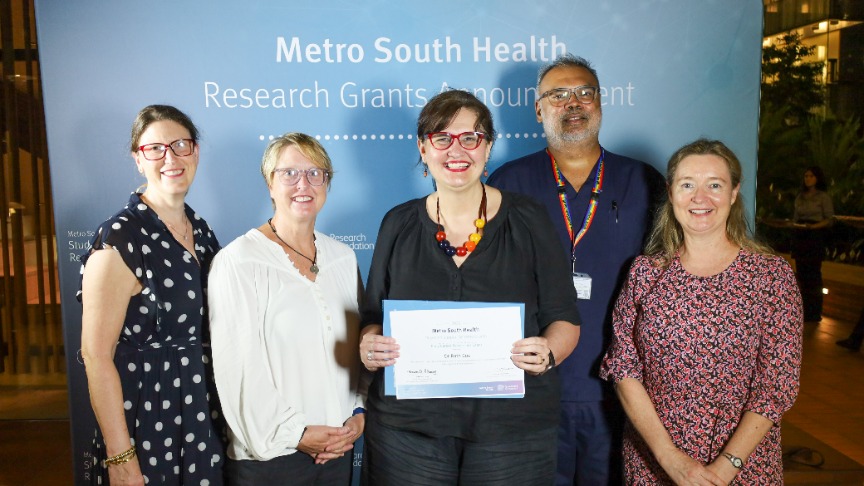
Research underway at QEII Jubilee Hospital is helping identify practical ways to strengthen compassion-centred care and enhance the patient experience.
Co-led by Dr Ruth Cox, QEII Hospital’s Director of Occupational Therapy and Dr Jayne Hewitt, Senior Research Fellow (Nursing), the mixed-methods research project aims to address gaps in peer-reviewed evidence guiding the delivery of person-centred compassionate care (PCCC), with a focus on improving healthcare quality, safety and wellbeing for patients.
“Our study explores how patients experience compassionate care, to better understand what is working well and where there are opportunities to improve,” Ruth said.
Jayne said the project is being delivered in two stages.
“In Stage 1, 60 patients from medical and surgical wards 2B and 4A completed the Sinclair Compassion Questionnaire (SCQ) in the first half of last year.
“Five qualitative questions were also included, and an additional group of 20 patients and/or carers participated in structured interviews later in the year. Data analysis combined descriptive statistics with reflexive thematic analysis.”
Findings showed patients were generally satisfied with their hospital experience, while also highlighting small but meaningful moments that shaped how care was perceived.
“Many of the people we spoke to were living with complex health and social issues,” Jayne said.
“They told us that the reasons someone presents to hospital are not always obvious, and that they value staff taking the time to understand their circumstances rather than making assumptions.”
Patients also spoke about vulnerability during hospital stays and the power imbalance that can exist within healthcare relationships.
“It’s the idea of ‘walking a mile in someone else’s shoes’,” Jayne said. “When people are unwell, they often feel a loss of control, and that uncertainty can be difficult to sit with.”
The project has now moved into Stage 2, which involves co-design workshops with consumers and healthcare professionals to develop a compassion-centred care intervention.
“We’ve shared the findings with patients and staff and, together, identified a range of possible interventions,” Jayne said. “The group has agreed to focus on improving patient journey boards at the bedside.”
The aim is to ensure journey boards better reflect what matters most to patients on any given day, while remaining practical for staff to use.
“There is real potential to strengthen how these boards support communication about a patient’s needs and priorities,” Jayne said. “We’re focused on incorporating patient and family feedback without adding to nursing workload.”
Phase 2 workshops with staff and patients are being completed this week to help define how the revised journey boards can be implemented across the hospital.
The research team includes Professor Liz Ward, Dr Emilia Dauway, Dr Sanjeev Naidu, Dr Jodie Nixon, and consumer partners Mr Alex McConnell and Dr Faiza El-Higzi.