
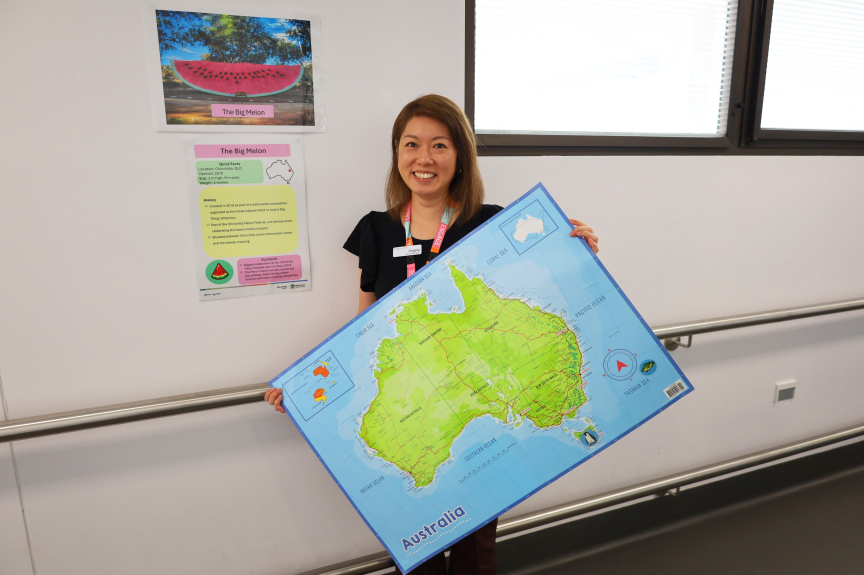
 Eat Walk Engage Facilitator Angela Lee
QEII Hospital patients are visiting Australia's biggest landmarks without leaving the ward thanks to Eat Walk Engage Facilitator and Senior Dietitian, Angela Lee.
Angela led the initiative to improve patient mobilisation and health outcomes, which won 'Most Innovative quality improvement initiative’ at the Quality Improvement Symposium held in September.
"We wanted to make ward 5A welcoming for patients," Angela said.
Surveys conducted last year showed patients didn't feel confident navigating the ward, even if they were able.
Acting on this feedback, Angela and a multidisciplinary team worked to find a solution.
"What we like about the Australian ‘Big things’ theme is that patients can relate to these landmarks and have potentially already visited them in real life," she said.
"It's meaningful for people and provides a sense of familiarity."
The team created a brochure with information on safe mobilisation and a floor plan of the ward, alongside landmark posters to help orient patients.
Patients can measure their walking goals using the landmarks. They can even take part in a bingo activity, winning a small prize when they cross off all the landmarks.
"It's really important to change ward culture, we can't be afraid of patients getting out of bed," she said.
"Every conversation about mobility matters, and if a brochure or poster helps start the conversation, it can make a big difference to patient outcomes."
If the 12-month pilot is successful, the team hopes to make it a permanent feature that could be adopted by other wards across the health service.
Evidence suggests hospitalised patients need to walk 900 steps per day to reduce their risk of hospital acquired functional decline.
"If we want our patients to be ready for home, we want them to be functioning here as if they were at home," she said.
"The sooner they are up and moving, the sooner we can get them home."
Eat Walk Engage is an evidence-based program designed to reduce delirium, functional decline and reduce length of hospital stay in older patients.
The program achieves this through coordinated support from multi professional assistants (MPAs) and implementation of quality improvement initiatives on wards.