
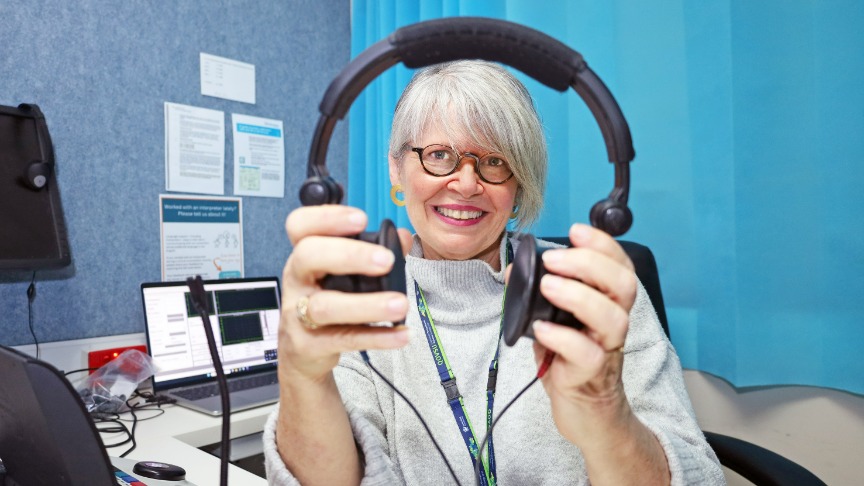
After 30 years as an Audiologist at Princess Alexandra Hospital, Megan Haynes has seen and heard the technological revolution sounding in real time across the duration of her career.
Graduating in 1982 and working in Sydney and England for almost a decade in the world of hearing aids, her transition to the specialist rehabilitation centre at PAH in 1993 means she is well positioned to reflect on the changes within Audiology.
Starting with the modernisation of hearing aids from wire cords attached to a box that you held in your pocket, through the 90’s versions of hearing aids held behind the ear, she said that technology in audiology has maintained tempo across the technological revolution.
“Now of course you can Bluetooth to everything, hearing aids are practically invisible, and some models can be left in your ear for three months before you have to take them out,” she said.
Training in the profession also increased exponentially because of inroads made by the private sector into the pensioner market resulting in a need for more audiologists to meet accreditation requirements.
“Most audiologists will go into hearing aids in the rehab space,” Megan said. “Fewer places exist in hospital-based diagnostics, so if you enjoy it – which I do – you jealously guard the position.
“Diagnostic audiology is a bit like being a detective. You are presented with a conundrum and while some of these are straight forward, there are a variety of actual and psychosocial presentations that mean you have to weed out the unimportant bits and put that into a meaningful context so that specialist groups in ENT, Infectious Diseases, Neurology, Oncology or Brain injury can do something with it.”
She said this unique insight of working at PAH which runs the biggest Brain Injury Unit in the state is a real gift. It involves diagnosis in the acute phase, shared learnings within tertiary training and then guidance for those seeking follow-up in the community years later when the long-term impacts of their brain injury are affecting their hearing.
While some confounding cases are referred to PAH Audiology to test the diagnostic boundaries, there are an array of cases that range from genuine malingering to those who have psychosomatic disorders. Here is where the detective work begins.
“I one had a case where a man with hearing aids spoke normally when having a conversation but changed his style of speech on testing. This turned out to be something he was adopting based on a friend who was deaf,” she said.
“This wasn’t malicious as he genuinely believed and identified as someone with a disability but the work we needed to do was about diagnosing him accurately, providing information to his referring doctors and connecting him with the right community supports for recognition and awareness.”
Successful intervention involved recognising the needs of the patient, approaching in a constructive but non-confrontational way, and flagging the supports they need to have around them to prevent relapses in behaviour.
Megan is very passionate about and has enjoyed adult diagnostics.
“Adult health is very interesting, and after 30 years working at PAH, I can say the support of the leadership has enabled us to expand the service as needed,” Megan said. “The collegial relationships across the professions make it a really nice space to work in.
“I wouldn’t have wanted to do it any other way.”
Congratulations on over 30 years at PA Hospital, Megan and happy retirement!