
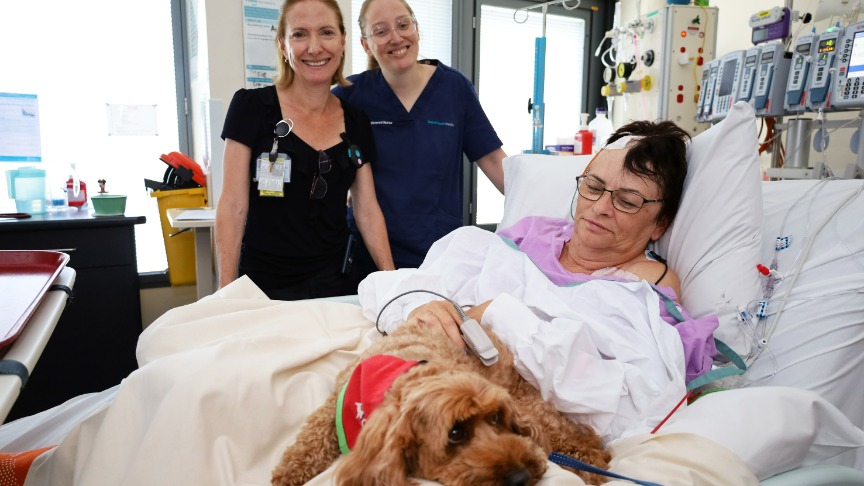
Some friendly faces of the four-legged variety are bringing comfort, connection and a much-needed distraction for critically ill patients and their families in the Intensive Care Unit (ICU) at PA Hospital.
Supported by a Metro South Health Novice Research Grant, the project to evaluate the impacts of weekly Delta Therapy Dogs visits for patients, visitors and staff in the unique environment of the ICU was led by Clinical Nurse and Principal Investigator in ICU, Tania Lovell.
“Our Clinical Nurse, Penny, had experience with Delta Therapy Dogs through different wards within the hospital and we wanted to see whether the same intervention could be brought to ICU with positive results,” said Tania.
“This project has been more than four years in the making, and its success is a direct result of the tireless effort and partnership with ICU leadership, the research team, Infection Control and Delta Therapy Dogs.”
Delta Therapy Dogs is an Australian non-for-profit organisation providing animal-assisted services through specially trained volunteer therapy dog teams, connecting people and animals to bring joy, comfort and wellbeing across health, aged care, education and community settings.
“ICU can be a challenging place for patients and families,” Tania said. “Creating even a small moment of comfort and connection - and supporting staff wellbeing - has motivated me to keep driving this project forward,” she said.
The Animal-Assisted Activities (AAA) intervention involved weekly 90-minute sessions delivered to eligible patients in ICU who were carefully screened with clinical oversight. Visits included bedside interactions for suitable patients, time for staff to interact, and a stop in the waiting area to support families.
Patients, visitors and staff provided survey feedback for the research team around their experience, mood, and stress, alongside a clinician’s perspective of the AAA visit impact on the patient.
“A unique strength of this project was its multidisciplinary design, showing the wider ways, therapy-dog visits can support the ICU community. This included planned interactions for patients, families and staff, support around family meetings and bereavement, student support, staff debrief moments, and relationship-building with teams across the hospital,” Tania said.
During the study, Delta Therapy Dogs and their handlers conducted 25 sessions, interacting with a total of 707 staff, 51 patients, and 194 visitors.
The majority of survey respondents across all groups reported improvements in mood and reduced stress with acceptability for the intervention reported at 97 per cent for patients, 99 per cent for staff and 100 per cent for visitors.
“The reports from staff centred around the positive energy within the ICU and the effect the visits had on their patients with reduced stress and something else to focus on,” Tania said of the study results.
“One patient summed it up beautifully as a happy part of the day that made them feel good. They felt it was important for people to have human-animal connections, especially in hospital.”
There are less than 10 published papers worldwide evaluating AAA in the ICU environment with limited safety-related data reported, making this project key to evidence and feasibility.
Tania said the team is now finalising analysis and preparing the findings for conference presentations and peer-reviewed publication, along with practical learnings to support other services interested in adopting AAA in ICU.
“We’re hopeful this project will strengthen the evidence base for Animal-Assisted Activities in ICU and programs like this will broaden the ICU therapeutic ‘toolkit’ for patients, families and staff,” Tania said.
A big thank you to Delta Therapy Dogs, the research team and PAH’s amazing ICU team for making every meaningful visit safe and special.