
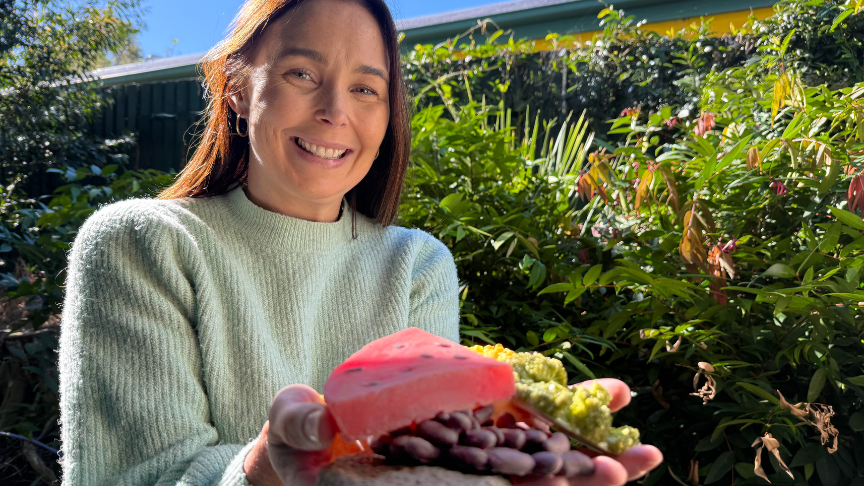
Senior Community Nutritionist for Addiction and Mental Health Services Donni Johnston was invited as one of twenty participants to pitch a novel pilot study exploring the role of food preparation in the mental and physical health of people living with schizophrenia at the Queensland Health Research Excellence Showcase.
Donni who has worked with Metro South for 15 years, presented the Schizophrenia, Nutrition and Choices in Kilojoules (SNACK) study which tested two nutrition intervention options: pre-prepared frozen meals (as currently provided through NDIS) and meal kits that enable participants to cook at home.
The study worked with 18 adults with schizophrenia across Metro South, randomly assigned to four-week phases of receiving either meal kits or pre-prepared meals, with a four-week control period supported by grocery vouchers.
“People living with schizophrenia often face challenges with what we call ‘food use skills’, things like planning, shopping, and cooking. These can be cognitively demanding tasks,” Donni said.
“We wanted to see which of these meal interventions might best support their needs and give us evidence to potentially advocate for more flexible options through the NDIS.”
“Participants said having a meal kit gave structure to their day and a sense of purpose. One participant even posted a photo online of a dish they made, and a friend thought it came from a restaurant. That feedback and that sense of pride was amazing,” she said.
While pre-prepared meals were easier, they often lacked the joy and sense of purpose associated with cooking.
Early data during the trial suggests that participants’ vegetable intake doubled or tripled on the days they ate the trial meals , a significant outcome, given the typically low intake of fruits and vegetables in people with severe mental illness. People living with schizophrenia in Australia die, on average, 16 years earlier than the general population often due to preventable physical health conditions linked to diet and lifestyle.
The findings add to a growing body of evidence highlighting the hidden burden of psychosocial disability, particularly the cognitive and executive functioning impairments that make everyday tasks like cooking far more difficult than they appear.
“We’re seeing that people with severe mental illness can take up to three times longer to shop or cook a meal compared to the wider population,” she explained.
“And because those challenges are invisible, they don’t attract the same support that a physical disability might.”
Looking ahead, she hopes to expand the study to a larger trial and ultimately influence NDIS policy.
“Right now, the NDIS mostly funds pre-prepared frozen meals. But we’ve seen that meal kits while requiring more effort could be a better fit for some people, especially when matched to their cognitive and functional profiles. We’d love to see a more tailored approach,” said Donni.
For this seasoned community nutritionist, research was a natural progression born out of a passion to improve care.
“It came from just wanting to do better,” she said.
“We’ve all seen these struggles in practice, but no one had pulled the evidence together. That’s why this work matters.”
The SNACK Study, led by Dan Siskind, was funded through the Metro South Research Support Scheme and delivered in collaboration with a team of researchers from Metro South Health, the University of Queensland, the University of New South Wales, Deakin University and the Queensland Centre for Mental Health Research.