
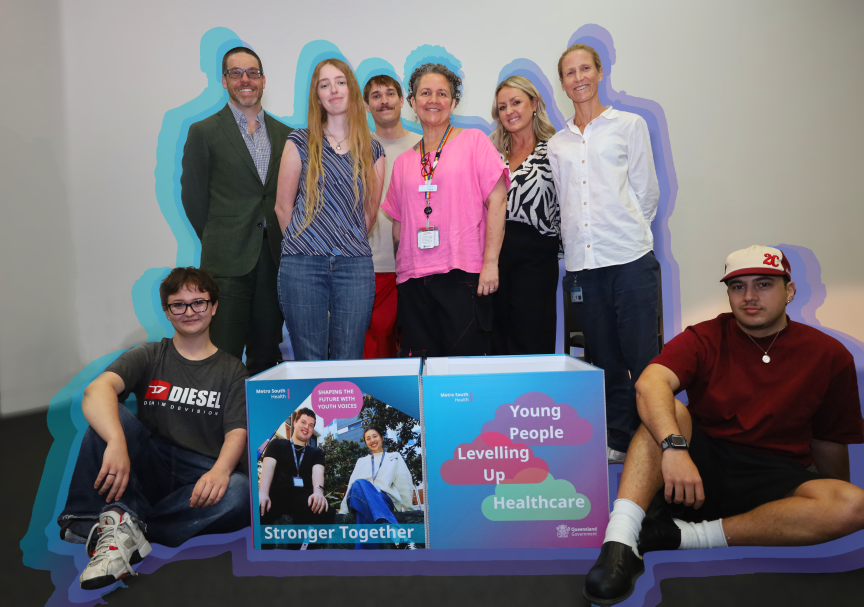
Metro South Health (MSH) clinicians are being encouraged to build trust, listen without judgement and put young people at the centre of their care thanks to the Adolescent and Young Adult Health Professional Education Roadshow.
The Roadshow was born from a recent survey that identified young people were overrepresented in emergency department presentations across Queensland. 15–25-year-olds make up 20 per cent of the population and current data indicates there is work to be done in the space of transitional, safe and responsive health care.
Thanks to a partnership with Queensland Child and Youth Clinical Network (QCYCN) Adolescent and Young Adult (AYA) Subnetwork and the MSH Youth Advisory Council, the MSH Roadshow, delivered to hundreds of clinicians across MSH facilities, challenged the standard assessment when providing care to a young person
“When a young person struggles to engage with healthcare, the key to understanding why may lie beyond what clinicians see in the consultation room,” said Katie Lindeberg, Co-chair of the QCYCN AYA Subnetwork.
“When we understand the context, the behaviour looks different. The question changes from ‘why won’t this young person engage’ to ‘what is happening in this young person's life that may be making engagement difficult’,” Katie said.
For young people, being included in decisions about their own healthcare can make a significant difference.
Youth Advisory Council consumer panellist Jaylyn said he valued healthcare professionals who made a conscious effort to involve him in conversations and decisions about his care.
“I'm the one who's receiving the care, so I think I should have the say in how I receive it,” Jaylyn said.
“I would really appreciate it when the healthcare professionals would go out of their way to make sure that I'm included in the decision making and all the conversations.”
Fellow Youth Advisory Council consumer panellist Isabella said positive healthcare experiences were often shaped by clinicians who took the time to understand the person.
“What has stood out as good healthcare is often when they engage with you as an individual rather than just your diagnosis and symptoms and gauge who you are as a person,” Isabella said.
“You can't provide quality care without developing relationship, rapport and trust with young people. It just doesn't work,”
The Roadshow also challenged clinicians to approach complex situations with compassion, recognising that a young person's circumstances and behaviours should not determine their worthiness of care.
Dr Henry Goldstein, Co-chair of the QCYCN AYA Subnetwork reminded participants that young people who present with identifiable health risk factors, such as substance use, still deserve the same respect and consideration as any other patient.
“That doesn't make a young person bad or naughty, or any less worthy of care than any of our other patients, or any less worthy of protection,” he said.
“A young person's encounter with a health care professional in an emergency environment is a developmentally formative experience of healthcare that they will carry with them as they continue to grow and develop their belief system.”
“When we’re working with young people, we need to model that all people are equally worthy of our care, and we need to carry that over in our interactions with others.”
The Roadshow's practical approach to education is already making a difference to clinicians' confidence, with 97 per cent of surveyed attendees saying the Roadshow improved their confidence in providing quality AYA care, with many reporting that they are developing new strategies and techniques for engaging with and caring for young people.