
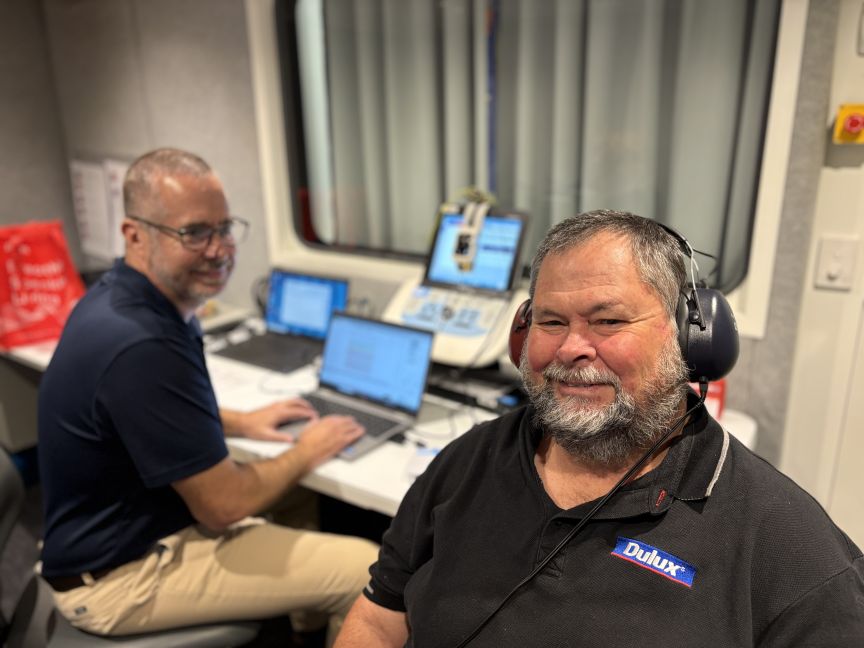
An audiology service at Redland Hospital is helping treat the hidden impact of autoimmune disease, where symptoms like hearing loss are often invisible.
Victoria Point resident Rodney Chapman is at the start of his hearing loss journey after being diagnosed with ANCA vasculitis, a rare condition that can cause inflammation and damage to multiple organs.
Mr Chapman first presented through Redland Hospital’s Emergency Department, spending about 10 days in hospital while his condition was diagnosed and treated.
“I had lesions all over my legs and my kidneys were closing down,” he said. “I consider myself very lucky. I was diagnosed quickly … things could be a lot worse.”
Mr Chapman said one of the hardest parts of the disease was that it wasn’t always visible.
“It’s like a mental illness. No one can see it,” he said. “The everyday stuff behind the scenes, it is hard … it does knock me around. I have days where I just crash.
“With my experience with this disease, I can’t recommend Redland Hospital highly enough. I really can’t praise them enough,” he said.
Mr Chapman continues to receive specialist care through Princess Alexandra Hospital and Logan Hospital, including MRIs and ongoing treatment.
“It’s so much easier to come here than it is to the PA … it makes it a lot easier and reduces stress,” he said.
Bayside Health Service Director of Allied Health Michael Harris said local access to audiology was making a real difference.
“For patients with complex and often invisible conditions, having access to hearing diagnostic services locally reduces travel, supports earlier intervention and keeps people connected to care,” he said.
Audiologist David Patmore said testing provided a clearer picture to guide treatment.
“Our equipment is extremely sensitive and provides more information than the average hearing test people might experience. There’s a whole lot more information we can get, which helps the treating team work out what to do next,” he said.
“Hearing loss is also very much an invisible condition which can be difficult for patients and their family to deal with.”