
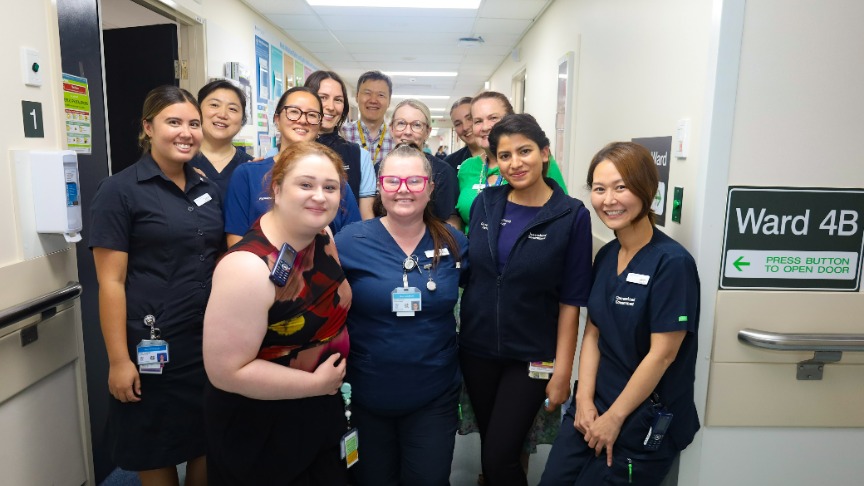
QEII Hospital’s Acute Stroke Unit has been awarded Gold Status through the World Stroke Organization (WSO) Angels Awards, recognising the hospital’s excellence in delivering fast, high-quality, evidence-based stroke care.
QEII is one of only six hospitals in Queensland to achieve Gold Status in the latest round of the international awards for meeting rigorous benchmarks in acute stroke treatment, including speed of care, adherence to clinical guidelines, data quality and continuous improvement.
The Angels Initiative and the Australian Stroke Clinical Registry (AuSCR) formally acknowledged QEII’s performance, describing the achievement as a significant milestone and recognising the hospital as a leader in stroke care.
QEII Acute Stroke Unit Clinical Nurse Consultant (CNC) Jenny Kim said the recognition reflects the commitment and coordination of the hospital’s multidisciplinary stroke care team.
“This award confirms that people experiencing stroke can have confidence they will receive timely, high-quality care at QEII,” Ms Kim said.
“It recognises the dedication of our clinicians across emergency, radiology and the Acute Stroke Unit who work together to deliver the right treatment at the right time.”
Rapid treatment is critical in stroke care, with research showing that for every minute a stroke goes untreated, the brain loses an estimated 1.9 million neurons. Faster intervention reduces disability, improves recovery and saves lives.
Ms Kim said QEII’s Gold Status was supported by significant improvements in the time from hospital arrival to the delivery of clot-busting treatment for eligible patients, what is known as door-to-needle (DTN) time.
In the latest reporting round, QEII treated 50 per cent of stroke thrombolysis cases in under 60 minutes, a substantial improvement from a previous average DTN time of 105 minutes and a benchmark aligned with international best practice.
“Reducing door-to-needle time has a direct impact on patient outcomes,” Ms Kim said.
“Faster treatment means more brain tissue is preserved and better long-term outcomes for the patient.”
Stroke patients presenting to QEII are managed through a rapid, coordinated emergency response designed to expedite diagnosis and treatment, known as a Code Stroke pathway. The pathway includes immediate triage, priority medical imaging and consultant-led decision-making to deliver live-saving reperfusion therapy, supported by national Stroke Foundation guidelines.
The integrated model relies on close collaboration between the Emergency Department, radiology services and the hospital’s dedicated Acute Stroke Unit.
QEII treated approximately 220 acute stroke patients in the past year and is one of only nine hospitals in Queensland to have ever received a WSO Angels Award. It is the second time the hospital has been recognised through the program.