
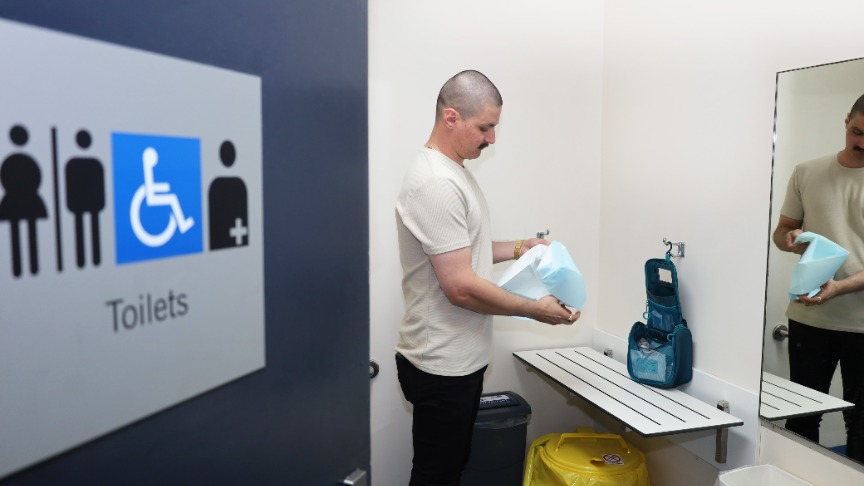
Princess Alexandra Hospital has taken an important step forward in inclusive, patient-centred care with the introduction of an ostomy-friendly toilet.
The project was driven by the voice of passionate consumer Jordan, whose life was turned upside down after severe stomach pain resulted in a cancer diagnosis at just 29-years-old.
“It all happened around Easter last year, it was the worst pain I’d had in my life,” he said.
“After visiting multiple GPs, I was referred to a gastroenterologist who immediately put me in for a colonoscopy. Straight after the colonoscopy I was told they found a pretty big blockage which they thought was cancer.”
Jordan was admitted to PAH and prepped for surgery as staff spoke with him about the chance of an ileostomy, which is a procedure that diverts the small intestine through an opening in the abdominal wall known as a stoma.
“That was the first time I'd even heard of an ostomy. And then after surgery I looked down and there's this bag of blood and weird, goopy stuff which looked like my insides were on my outside.”
With support from the PAH Stomal Therapy Wound Management team, Jordan adapted to life with an ostomy while receiving cancer treatment.
“Living with the ileostomy is actually not bad, I mean it saved my life. But using the bathrooms anywhere, not just at the hospital, was a struggle and it was messy.”
Jordan raised the idea of an ostomy-friendly bathroom, commonly found overseas, especially in Japan and Europe.
Approximately 50,000 people in Australia have a stoma which CNC Lucy Perovic said is also considered an invisible disability.
“Completing ostomy changes in the public setting can cause stress and anxiety for people due to lack of amenities and space available in a single cubical,” she said.
“We are proud to be able to modify the first ostomy friendly toilet for Metro South Health here at PA Hospital on ground floor of the main building.
“This modification includes Ostomy Friendly Bathroom sign alongside the wheelchair logo, accessible hand hygiene, a bench for people to place their ostomy products on for changes, and clinical waste bin as well as the ability to use the mirrors for changes.”
The simple modification has made a significant difference to Jordan, and the many others who will benefit in the future.
“I used it last time I came for chemo and it’s awesome,” he said. “It’s exactly what I wanted it to be and makes me feel super proud to be at PAH. This is great for the community.”
Beyond functionality, Jordan hopes the initiative will also spark greater awareness.
“I'm hoping even the sign itself will catch people’s attention as they walk past and create some curiosity or education.”
Well done to everyone involved in the installation of the ostomy-friendly toilet, and thank you to Jordan for being an incredible advocate for patients and driving meaningful change.