
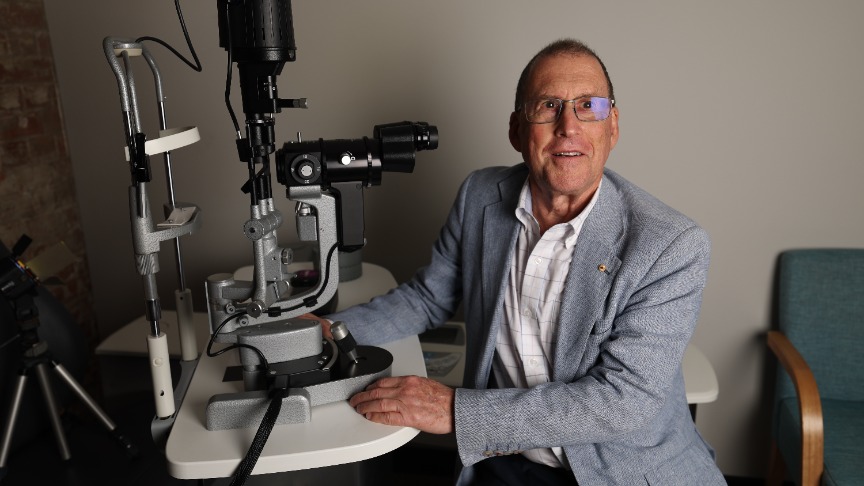
The founding medical director of the Queensland Eye Bank, Prof Lawrence Hirst has seen his way through 38 years of dedication to the delivery of eye tissue to thousands of Queenslanders.
The eye bank (QEB), which is now part of the Queensland Tissue Bank, is the largest ocular tissue bank in the country, processing over 500 donors a year, and supporting approximately 1000 corneal transplants every year.
During Prof Hirst’s leadership of the QEB between 2007 and 2022, over 15,000 donors were screened for successful ocular tissue donation – providing over 30,000 corneas for transplant.
One of the professor’s greatest successes was the establishment of automatic death notifications to the tissue bank, via the hospital computer system HBCIS, which enabled rapid screening and more opportunities for families to choose donation.
“You can only donate tissues up to 24 hours after death, so timely notification supported these efforts,” Prof Hirst said. “This was the very first time in Australia that this form of notification was used – it is still the envy of some states.”
But this journey to success had humble beginnings.
Prof Hirst commenced a two-year internship at PAH in 1970, with his training and career taking him to the Royal Victorian Eye and Ear Hospital in Melbourne, The Johns Hopkins Hospital in Baltimore, Bethesda Eye Institute in St Louis, before finding his way back home to Brisbane in 1986.
In his role as the inaugural Chair of Ophthalmology at University of Queensland, based at Princess Alexandra Hospital, he set about establishing processes, quality controls, transplant waiting lists, dedicated theatre time for tissue retrieval, and documentation to measure patient outcomes.
Reflecting on these early years, Prof Hirst said if a patient required a corneal transplant, their name was written on a whiteboard in the nurses’ office, and only when a registrar had time, they would enquire about potential donors/deaths and following consent from the family, perform the retrieval.
“Basic serology was undertaken with very limited quality control. Patients had to wait 6 to 12 months to receive a cornea with surgery after-hours as emergency patients,” he said. “There was very limited documentation of this process, nor effort to understand patient outcomes.”
With no funding or staff, Prof Hirst set about raising ~$250,000 towards the QEB through Jupiters Casino Fund, Charlie Viertel, Lions Club and individual donors, eventually being allocated two positions and three rooms in the iconic PAH Diamantina House.
The Queensland Eye Bank commenced in 1988 and by 1992 it was the best performing in the country receiving an officially opening ceremony before it’s move in 1994 to the offices in the basement of the PAH Spinal Injuries Unit building. It remained there until the integration with Queensland Tissue Bank (QTB) at Coopers Plains in 2021.
Prof Hirst remained the Medical Director of the QEB until this year when he quietly stepped out of frame from his leadership role.
In kind words to his colleagues at QTB, he said they had all been the reason that he stayed so long.
“It is because you put such dedication and effort into the goal of providing quality tissue to all who need it that I have stayed. I feel that now is the right time to hand over the reins.”
It is testament to Prof Hirst that over 38 years of dedicated service has contributed to Queensland’s significant success in corneal transplantation.
While he has turned his eye to other pursuits, remaining active in the Australian Pterygium Centre and writing scientific articles and a book, you can still see his influence in the PA Theatres complex where his exceptional photography of wildlife continues to minister to the eyes of all who behold.
Thank you for your many years of dedication to the eyesight of Queenslanders, Prof Hirst.
More about QTB:
Queensland donors and the work of QTB support more than 30 per cent of all corneal transplants in Australia. The QTB also provides occasional supply of cornea to New Zealand, New Caledonia, Noumea, South Korea, Japan and Taiwan.
Patients can be booked for elective surgery two weeks in advance, with tissue also available for emergency cases.
Anyone who needs a corneal transplant in Queensland, will receive one.