
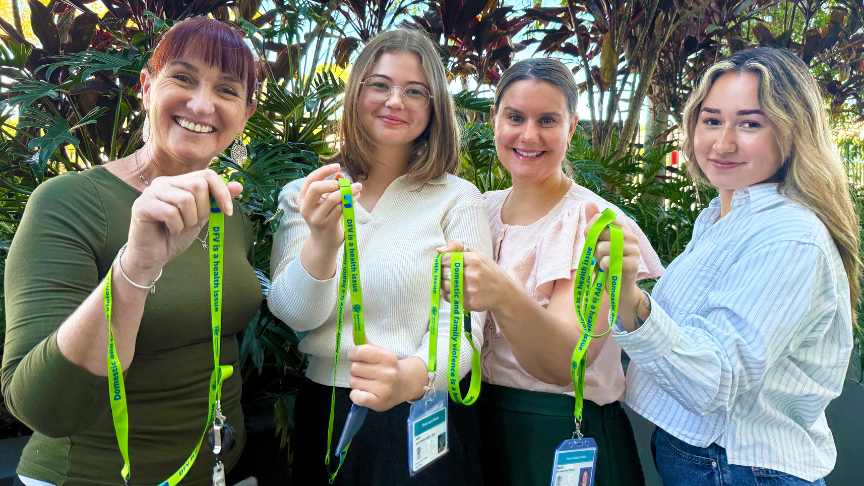
Behind Metro South Health’s growing ability to respond to domestic and family violence (DFV) is a small but mighty team committed to reshaping how healthcare recognises and addresses abuse.
The DFV Specialist Workforce Team consisting of Advanced Social Worker Cindy, Senior Social Worker Jodie, and Student Social Workers Grainne and Mariah are leading the charge to build capability across the health service. Their mission is to ensure every staff member can respond safely, sensitively, and effectively to patients impacted by DFV.
“Health services are often the only safe place a person can access support,” said Cindy.
“A caring response from a staff member can be life-changing; helping someone feel heard, seen, and offered safety options.”
Through clinical consultations, training, awareness events, and integration into the broader DFV sector, the team is embedding DFV as a recognised health issue across Metro South Health.
Queensland recently criminalised coercive control in May 2025, part of sweeping state-wide reforms. DFV remains a significant public health issue, affecting one in four women and one in 14 men in Australia with even higher rates among First Nations, LGBTQI+, elderly, and people with disability.
The team has already trained more than 1,700 staff in the past year and is now rolling out non-fatal strangulation training. They’re also leading a monthly virtual session series with external experts including a QPS session on implementing coercive control legislation.
“DFV is everyone’s responsibility,” said Cindy.
“We want all MSH staff across clinical and non-clinical roles to feel equipped and supported. This work is complex, but no one has to do it alone.”
The team is also developing a network of “DFV Champions” across professions and services. Their work is grounded in trauma-informed care, culturally safe practice, and genuine engagement with people with lived experience.
Because when every staff member is prepared, every patient has a better chance of safety and support.