
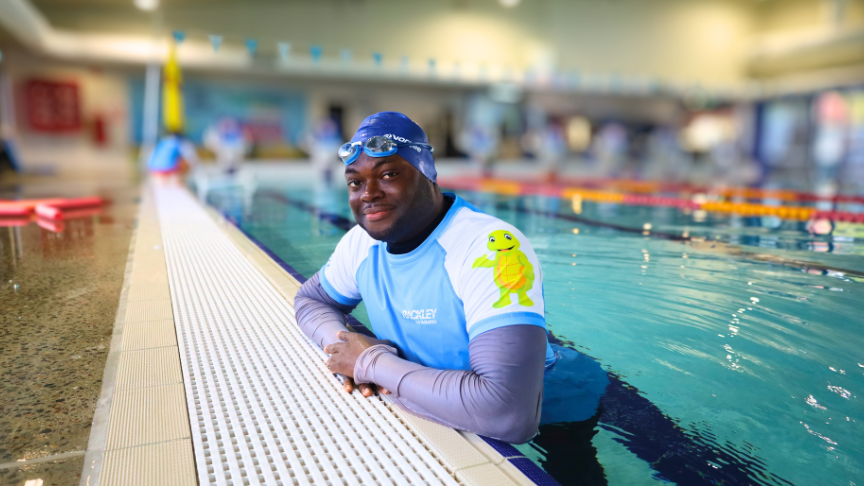
As Australia braces for another hot summer, a unique program is helping culturally, and linguistically diverse (CALD) communities build life-saving swimming skills – while also breaking down barriers for carers of people with disability.
Since its inception in 2003, the Aqua English Project Ltd in partnership with the Metro South Health, Health Equity and Access Team has provided swimming and water safety lessons tailored to migrants, refugees and carers, with more than 246 newly arrived participants from across the globe – including Syria, Sudan, Afghanistan, Burundi, Cambodia, Iran, Ukraine and beyond.
The program was developed to address major discrepancies in health statistics that the CALD communities face:
- CALD individuals are over 2.5 times more likely to drownthan Australian-born individuals (Royal Life Saving Australia, 2023), with those with a disability within this group at higher risk.
- Only 24 per cent of adults with a disability experience very good or excellent health, compared with 65 per cent of people without a disability.
- Most drowning deaths happen within 5 years of a migrant’s arrival in Australia (Pidgeon, 2024).
The program combines English language learning with aquatic skills, ensuring participants not only learn to swim but also gain the confidence to access pools, beaches and aquatic centres safely as well as increase their capacity as disability support workers.
For many, the experience is life changing.
For Benjamin, water was always a source of fascination – but never a place he felt safe. Growing up in the Democratic Republic of Congo, swimming lessons weren’t part of everyday life.
“I always loved the water,” he said. “But I never had the chance to learn. I would stand on the edge and watch, but I could never join in.”
Now, the pool is part of his everyday routine – not just for fitness, but for healing.
“When I get into the water, I feel my stress wash away. It lowers my blood pressure, calms me before work, and clears my mind. It is the best medicine I’ve ever had,” Benjamin said.
A former French teacher, Benjamin says swimming has also deepened his relationship with his children.
“Before, I didn’t know how to help them in the water. Now, I can show them, guide them, and keep them safe. We swim together, and it connects us as a family. It gives me joy as a father to share that with them.”
For Benjamin, the benefits go far beyond exercise. The water has become a safe place to manage stress, maintain his health, and strengthen his family’s wellbeing.
Sarah Scarce, Executive Director of Aqua English Project Ltd said the impact goes beyond swimming.
“This program is about empowerment. For many participants, it’s the first time they’ve felt safe and confident in the water. For carers, these skills mean they can take the people they support to pools or even the beach during summer, offering recreation, therapy, and inclusion that might otherwise be impossible,” she said.
“You can’t be what you can’t see,” Sarah said.
“When adults and children walk into the pool and see someone who looks like them, speaks their language, and teaches them to swim – that’s powerful. It’s why our retention rates are so high. Its why families keep coming back.”
Over the past two decades (2003–2025), the program has delivered:
- 42 targeted adult beginner swim programs, including aqua aerobics for people living with chronic pain.
- A pilot capacity-building program for disability carers and support workers.
- Representation of CALD communities in the aquatic workforce, where traditionally less than 10% of instructors are from culturally diverse backgrounds
- Lessons for hundreds of newly arrived refugees and migrants from more than a dozen cultural backgrounds.
With Australia’s climate getting hotter, program leaders say water safety is not just a skill, but a public health necessity.
“Swimming is part of the Australian way of life, everyone should know how to swim. For CALD communities and carers, that knowledge doesn’t just change lives – it saves them.”